
Leader in Keramat Mosque
Malihe Kamaledin
Translated by M. B. Khoshnevisan
2021-1-12
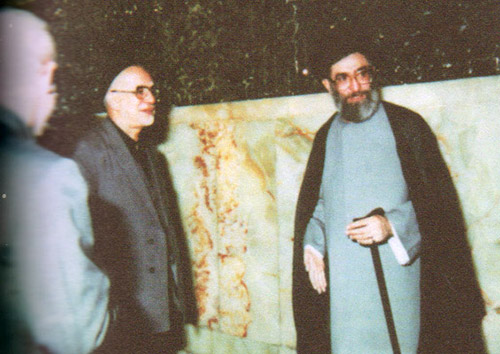
Keramat Mosque in the holy city of Mashhad is located near the holy shrine of Imam Reza (PBUH) and Ayatollah Khamenei was known as the fixed prayer leader of the mosque from Azar to Esfand of the year 1352 in the solar calendar (December 1973-March 1974). During his period as the prayer leader of the keramat Mosque, Ayatollah Khamenei had made the congregational prayer a memorable memory for the worshipers by paying attention to seemingly simple points. What you read below is oral narrations from this period taken from the book "Leader's Mosque" which is about the oral history of the Keramat Mosque.
***
Ayatollah Khamenei's relationship with the Keramat Mosque can be divided into four periods. The first period is related to before the conversion of the building of Keramat into a mosque, namely the years 1344 to 1352 (1965-1973), where there was no fixed prayer leader. The second period is from Mehr to Esfand of 1352 (October 1973-March 1974), when he first went to the Keramat Mosque several times a week to say prayers and gradually became the main imam of this mosque. Even after Esfand 1352 (March 1974), despite being banned from praying and lecturing at the Keramat Mosque by SAVAK, he maintained his connection with it. The fourth period is after the release from exile, namely Mehr to Dey of 1357 (October 1978-January 1979).
One of the main points during his period as prayer leader in Keramat Mosque, was the way he interacted with young people and adolescents. Morteza Ataee says in this regard: "In all mosques, young people were rejected, but one of the characteristics of the leader was that most of those who were attracted to him were young people and teenagers. It was very important to us that when I as a fourteen or fifteen year old teenager went and sat beside him, he spoke to me so generously that I thought he had been a friend with me for years."[1]
Ayatollah Khamenei himself says in a speech from the memoirs of that time: "At that time, wearing inverted furs was fashionable among the Beatle youths. One day I went to pray and saw one of these young men with oiled hair coming and sitting in the front row next to religious people and good bazaaris and white bearded people. I felt that this young man had something to say to me ... He came forward and said, "Sir!" Is it okay for me to sit in the front row? I said, yes there is no problem. You are like the rest. He said that but these gentlemen say that there is a problem. I said these gentlemen are talking nonsense. This young man never leaves this mosque anymore. He loves this prayer leader forever".[2]
Another positive aspect of his presence in that mosque was his good and pleasant recitation. "The Keramat Mosque gradually became very crowded," said Abbas Salimi Namin. The reason for this was that the prayer of Ayatollah Khamenei was attractive. In his younger days, he recited very beautifully ... ".[3] Seyyed Hussein Shafi'ee Darabi also says: "This recitation of the leader's prayer was very interesting. That is, now more than 35 or 36 years have passed since then, but I still feel the sweetness of the reciting of his prayers." [4]The correct Arabic tone and observance of the laws of Tajweed and reciting the surahs of the holy Quran in the form of recitations were so new and attractive to the people that Mohammad Javad Alami says that one of the simple-minded bazaaris had said that we did not have to go and pray behind an "artist mullah"![5]
In this regard, the late Abdolreza Ghanian and members of the Keramat Mosque took an interesting initiative to broadcast the audio of his prayers so that all worshipers hear his voice, and instead of using a Mokabber (a person who says Takbir aloud in congregational prayers so that the worshipers are informed of the movements of the Imam in the prayer), they installed three microphones in front of him. The late Ghanian says: "I came and put three speakers for prayer, which was not common in Mashhad at all. There was a microphone on the floor, one for Rokou' or bowing, and another for Ghiam or standing up. "Until the end of the prayer, all the women who prayed in the rooms of Keramat heard the sound of prayer."[6]
Recording his recitation and practicing correct recitation with it were other effects of this action. The late Ghanian says: "Some people had come from Tehran and they said, 'May God have mercy on your father.' We record the tape of this prayer, and take it to Tehran and give it to our wives and children so that they learn the prayer lesson beautifully. Thus, they don't have to go somewhere else.”[7]
Another measure of Ayatollah Khamenei in this mosque was that he prayed along with a sermon. Perhaps one of the reasons he turned to lecturing between and after prayers was that he was prohibited to lecture. His efforts to convey religious teachings led to a standing speech after prayer, which was not considered going up a Minbar or pulpit. Hujjat al-Islam Ajam says in this regard: "Because it was forbidden for him to go to the pulpit, he would stand up and recite a hadith after the prayer. Then, in that hadith, he spoke up.”[8] Mehdi Valipour also says: "He should not have spoken, it was forbidden. He stood up between the two prayers under the pretext of something, and later, if the government agents questioned him, he would say: Well, I have not gone up to the pulpit, I stood up and spoke. "With the crowd that was behind him, it was not possible for them to fight with him every day."[9]
On the other hand, Ayatollah Khamenei delivered speeches almost every day of the week during his time as the prayer leader of the Keramat Mosque. In this regards, he himself has said, "After a while I went to the mosque [Keramat] almost regularly, and maybe every week, I spoke there for six nights and a large gathering was formed there ..." [10]Innovation in the method of lecturing using teaching aids, presenting written summaries of topics, reviewing previous topics and giving the audience the pleasure of understanding the Qur'an were among the features of his lectures on those days. The content of these lectures also included seemingly simple topics, mixed ideological, ethical and political issues, current issues and answers to common doubts, categorized topics, as well as topics that evoked a sense of responsibility towards society. [11]
[1] Interview of Masjedia Journal with Morteza Ata’i
[2] Seyyed Ali Khamenei, Addressing NAJA Idealogical-Political Officials, 2005, Jan 3rd.
[3] Interview of the Office of Islamic Cultural Front Studies with Abbass Salimi Namin, 2015 May 17th.
[4] Interview of the Office of Islamic Cultural Front Studies with Seyyed Hussein Shafi’I Darabi, 2015 Jan 12th.
[5] Interview of the Office of Islamic Cultural Front Studies with Mohammad Javad A’lami, 2014 Sep 1st.
[6] Interview of Islamic Revolution Documents Center with Abdulreza Ghaniyan
[7] Ibid.
[8] Interview of the Office of Islamic Cultural Front Studies with Ali Ajam, 2014 Sep 12th.
[9] Interview of the Office of Islamic Cultural Front Studies with Mehdi Vali Niyapour, 2014 Sep 2nd.
[10] Interview of IRIB2 with Ayatollah Seyyed Ali Khamenei, 1985 Feb 1st.
[11] Selected from the book: The Leader’s Mosque, Oral History of Keramat Mosque, Morteza Ansarizadeh, Rahyar Publishing Co. 2020. Pp162-206.
Number of Visits: 5857



The latest
Most visited
- 100 Questions / 43
- The Third Regiment: Memoirs of an Iraqi Prisoner of War - 44
- Memories of Abbas Jahangiri
- Don't leave us indifferent
- The Miracle of Hafez
- 100 Questions / 44
- Review of the article “Pathology of Documentary Research of the American Embassy Documents”
- Oral history News for Mordad 1405 (July 23rd to August 22nd 2026)
100 Questions/ 34
To what extent are we allowed to use narrative techniques (however simple) in compiling an oral history text?We asked several researchers and activists in the field of oral history to express their views on oral history questions. The names of each participant are listed at the beginning of their answers, and the text of all answers will be published on this portal by the end of the week.
Validation: Challenges and Necessities
Where does truth stand in oral history? How can the correctness of a narrative be recognized? Does fact-checking matter? If there is exaggeration in the reporting of some accounts, how can it be detected? Is it possible to record an event accurately through the recording of a narrative? Readers and users of oral history works are often faced with these questions, and sometimes encounter doubts about some oral history works.From Revolutionary Circles to the Military Arm of the Islamic Government
In those days, it became clear that certain institutions had to be established very quickly—institutions suited to the temperament, expectations, and lingering aspirations of the younger generation; young people who had been politically active before the Revolution and, in some cases, had been directly entangled in arrests, imprisonment, ...Authenticating Oral History: From Possibility to Necessity
The use of oral history as one of the historical sources has long been one of the principal challenges facing oral historians and those who employ it in contemporary historiography. The development of international standards for oral history, as well as IRIB standards, was intended to address the criticisms raised in this regard. The relationship between Diplomatics in written records and oral history is reciprocal.
