Air Raid to Al-Waleed (9)
The Story of Demolishing Fighters and the Equipment in Al-Waleed Triple Military Bases Known as H-3
2016-2-21
Air Raid to Al-Waleed (H-3)
The Story of Demolishing Fighters and the Equipment in Al-Waleed Triple Military Bases Known as H-3
By: Brigadier General Ahmad Mehrnia
Tehran, Sooreh Mehr Publications Company
2010 (Persian Version)
Translated by: Zahra Hosseinian
Second unsuccessful Operation
We came close to the Nowruz. With some changes in the plan and leading of Lt. Col. Qasim Pourgolchin, then-commander of Hamedan air base, it was supposed that the pilots for eight aircrafts and two reserve pilots to be determined and the mission to be performed for second time.
First Lt. Pilot Fereidoun Mazandarani, who was busy serving along with pilot Aziz Bozorgnia in the Bonyad Shahid of Air Force to deal with families of martyrs, captives and missing persons, says:
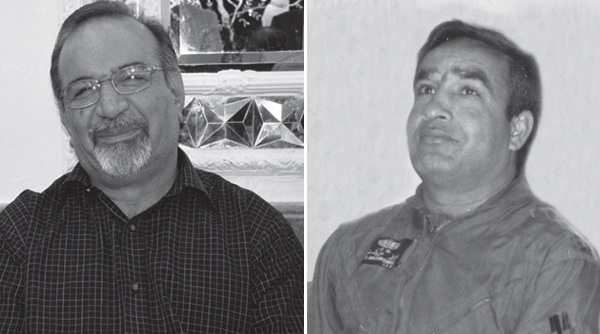
Col. Aziz Bozorgnia (1981) and Fereidoun Mazandarani (2008)
“According to command’s order, and with collaboration of Mr. Mehdi Karroubi, I was received by Imam to coordinate with and filled him in on. After hearing the generalities of mission and the necessity of carrying out this important operation quickly, Imam says: “do the missions by observing all safety precautions.” Quickly I returned to the Air Force headquarters and conveyed the leadership’s approval. During this mission, my responsibility incidentally was The F-14 air cover.”
Usually, base commanders were not deployed to combat missions; first, for political reasons and the importance of their special job, because if for any reason the enemy could shoot down their aircraft or captured them, it gained very valuable promotional material; and second, it had bad consequences on the spirit of insider pilots. So, knowing this, they themselves had no insistence. But commander Golchin[1], who determined offensive operation at the head of affairs of base with particular zeal from the first day of war, always phoned the command post of Tabriz air base - in a way that I (the author) witnessed it - and beside exchanging views with Lt. Col. Morteza Farzaneh Monfared, commander of base, coordinated aggressive flight plans with him. Maybe two command posts had sort of competition, lest a large difference occurred between the number of flights of air bases. Golchin was personally very interested in targeting the enemy and its military equipment. Therefore, with great insistence, he persuaded commander this time to accept his demands and assign the flight leader to him; and finally he was successful.
Retired Second Brigadier General Javad Varasteh (who was Major at the time), commander of one of Boeing 747, whose colleagues know him a good, quiet, and always smiling man, says:
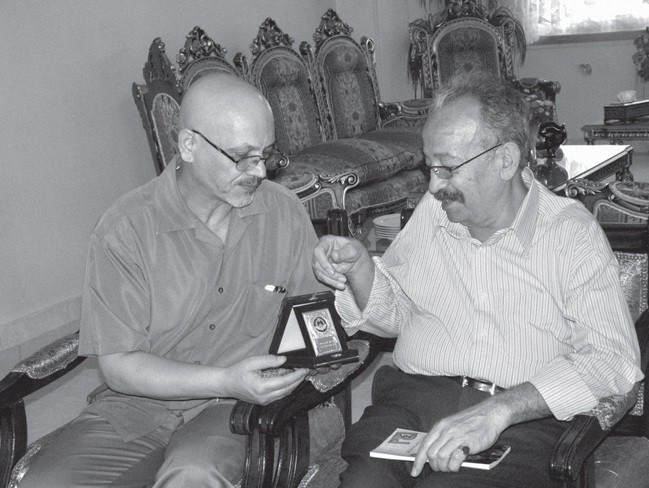
Second Brigadier General Pilot Javad Varasteh was receiving the ‘eight years dignity’ plaque from Ahmad Mehrnia on behalf of Studies and Research Office of Air Force in 2008
“We were justified for carrying out this operation. We should do the operation of tactical delivering fuel, which had been displayed only sometimes at the parade without fuel, in the real situation and at the far West border of enemy’s country, without any support and protection against possible attacks of Iraqis fighters! Doing the operation of delivering fuel with Boeing 747 at the height of less than thousand feet is easy in word, but in practice it has different hazards. However, we trusted in God and headed to Syria two days before operation and landed at the Damascus airport. Colonel Izadseta was with us in this mission and during the flight he stressed much on the importance of successful implementation of the operation. But we really were not sure that not caught in the trap of enemy’s fighters. But a good military person is one who obeyed his superior orders unquestionable and should be ensure that the decisions have been taken properly and with careful study. Tomorrow, the second tanker is joined us and we got ready to fly at operations day. This time, Izadseta was leading the operation in the second aircraft. All of coordination was done, allowing from control tower was done at the predetermined time, and with a few minutes interval, two aircrafts headed Tehran through international routes. It was supposed that we reached our height below thousand feet, without saying anything to the control centers, and became ready for delivering fuel to Phantoms. One of my concerns and my colleagues’ was that whether bombers can find us without radio communication and knowing our situation? If this not happened, what will occur? I sank into this thought that the time of decreasing the height came.”
Probably early morning of February 07, 1981, while sever chilling air of Hamedan, especially at the base which is 40 kilometers away from the city, was causing harassment any animal, the home phone of twenty pilots of front and rear cabin rang and was asked them to come to the command post. Technical staff of runway and aircraft guns had been working from last night and with a variety of considered ammunition, had made ten F-4 aircraft ready for a heavy attack to some targets deep inside Iraq. Of course, none of them knew where the targets are. But from the large number of being prepared aircrafts, they had guessed a very important plan is in advance.
[1]. Soon after the Banisadr story and his dismissal, most of the commanders of air bases were dismissed and released from service. In this regard and for unknown reasons, Mr. Golchin, who was brave and fearless commander, was encouraged to opt for voluntary severance on August 23, 1981 and left the Air Force.
Number of Visits: 6114
Share


The latest
- Narrative and the "War of Narratives" in the Era of Resistance and Imposed Wars
- Memories of Mohammad Boloori
- Call for Fundamental Questions in the Field of Oral History
- 100 Questions/49
- The Third Regiment: Memoirs of an Iraqi Prisoner of War - 49
- Jasem Ghazbanpour's narration of the first day of the war in Khorramshahr
- Memoirs of Ali Fadaei
- The Relationship Between Oral History and Biography
Most visited
- The Third Regiment: Memoirs of an Iraqi Prisoner of War - 48
- 100 Questions/48
- The Relationship Between Oral History and Biography
- Jasem Ghazbanpour's narration of the first day of the war in Khorramshahr
- Memoirs of Ali Fadaei
- The Third Regiment: Memoirs of an Iraqi Prisoner of War - 49
- 100 Questions/49
- Memories of Mohammad Boloori
100 Questions / 43
How can narrators and interviewers reach a common understanding?We asked several researchers and activists in the field of oral history to express their views on oral history questions. The names of each participant are listed at the beginning of their answers, and the text of all answers will be published on this portal by the end of the week.
Documentary Pathology of the US Embassy Documents
The Necessity of Scientific Rereading and Content Analysis of DocumentsMore than four decades have passed since the publication of the first collections of documents from the US Embassy in Tehran. However, despite the relatively easy access to this treasure trove of documents, systematic research exploitation of it has not been adequate. We still do not have a “comprehensive picture” of the content of these 11,000 documents.
100 Questions / 42
What is the importance of the narrator and interviewers shared understanding of the past in oral history?We asked several researchers and activists in the field of oral history to express their views on oral history questions. The names of each participant are listed at the beginning of their answers, and the text of all the answers will be published on this portal by the end of the week.
Validation: Challenges and Necessities
Where does truth stand in oral history? How can the correctness of a narrative be recognized? Does fact-checking matter? If there is exaggeration in the reporting of some accounts, how can it be detected? Is it possible to record an event accurately through the recording of a narrative? Readers and users of oral history works are often faced with these questions, and sometimes encounter doubts about some oral history works.