
Ahmad Ahmad Memoirs (39)
Edited by Mohsen Kazemi
Ahmad Ahmad Memoirs (39)
Edited by Mohsen Kazemi
Soureh Mehr Publishing Company
(Original Text in Persian, 2000)
Translated by Mohammad Karimi
Unsuccessful Jailbreak
Death penalty verdicts of 21 members of Ahmadzadeh Marxist group issued. I was thinking of a jailbreak and needed information to complete my plan. So I would gather preliminary information when going to interrogation sessions. I found out the prison had a north-to-south street that on its eastern side there was a building which had some windows opening to the street and some to the yard. The yard had a 3-meters-wall with a grating and on the other side of the wall there was river which was about six meters down the top of the wall. I mean the river was 3 meters lower than the yard. There was also a watchtower about 2 meters higher than the wall for guarding around the prison.
After gathering the necessary information, along with some members of Ahmadzadeh group, we began weakening two iron bars of the cell to escape through them. We unravel the rug in the cell and made thick rope out of it about 6 or 7 meters long.
We planned the jailbreak. First of all two of us had to jump on that watchtower and drop it down by force. It was possible that two people lose their lives. After the fall of the watchtower the rest had to go down the wall by rope and run away through the river.
We planned and finished all the details of our plan with Abbas Meftahi and Masud Ahmadzadeh. We arranged a meeting to finalize the plan. Unfortunately some evaded in this meeting. They had excuses like armed guards, Uzi machine guns and… They were stupid because most of them were about to be executed and there would make no difference if they die by death squad or killed when running away. The good thing about jailbreak was that they would become heroes. They were losing this chance by their opposition.
It was also possible to save others’ lives if some could escape and conduct propaganda after running away. Whatever I insisted it was useless and they did not change their minds. However, it was acceptable for me to change my mind because I had only to pass few years in prison and then I would continue my life. Being in prison was equal to be alive but running away would cost my life.
Anyway, when some avoided joining the jailbreak plan, it became useless because it was impossible to succeed by one person.
Another Trail
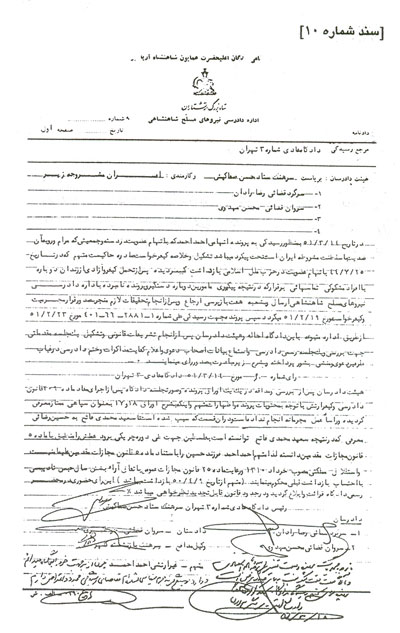
It was about one month that I was in the same row along with Fadayee guerrillas and would go for interrogation every day to military justice. On June 4th 1972 they told me the first session of my trial would be held. Hassan Safakish was the judge. In 1965 in INP members trail was general prosecutor. When I entered the court we knew each other. In this trial, Captain Nohsen Mahdavi and Major Reza Radan were assistant attornies, Captain Johary was prosecutor, and retired Colonel Kalhori was my referred lawyer. (Documents 7 & 8)
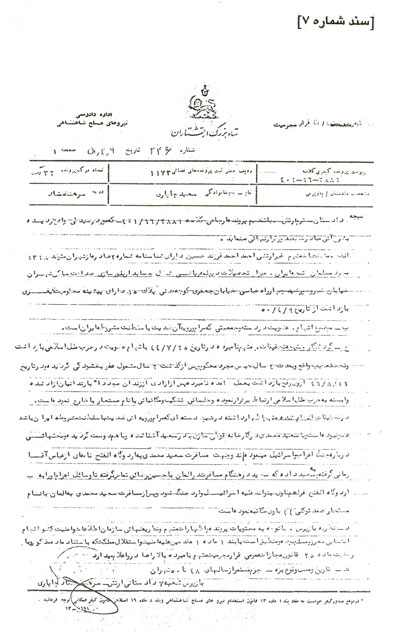
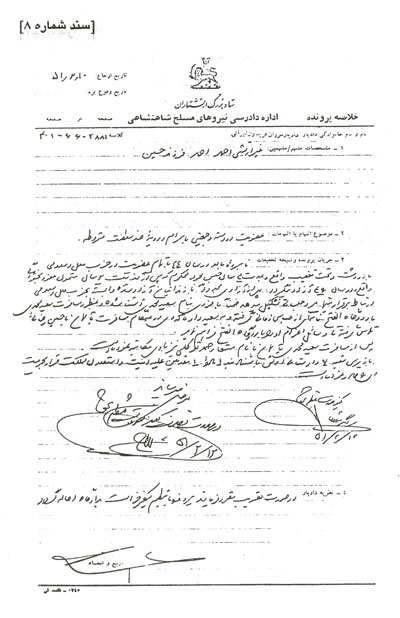
I had no hope for the defense that the referred lawyer would make for me; he had been the one who had ordered the trial and execution of many people and would do nothing for me as referred lawyer. He had no correct view about the prison and the accused. He also had no intention to make the accused free.
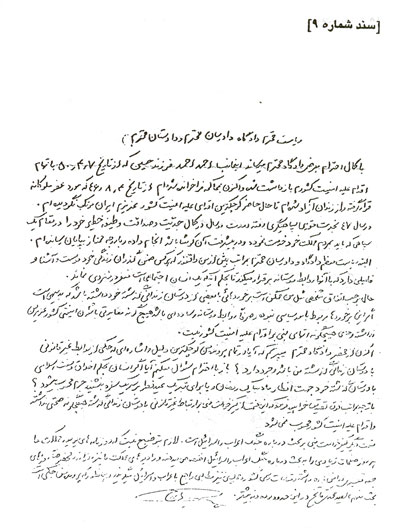
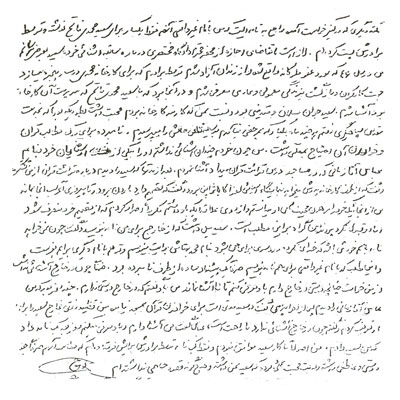
So when Kalhori began defending me, his defense brought the negative atmosphere to the court and made it legitimate. Watching his weak and negative defense made me stop him. I said: “I do not believe what he says” and then began reading my own. I had written that I was a patriot and being chosen as “The Excellent Corps Soldier” would prove it. Then I added having relation with some of freed prisoners was only a simple friendship and not political at all. And about the pseudonym, I claimed it was only a suggestion by Saeed Mohammadi Fateh who was my colleague when working at Mohammadi can-making factory. I rejected any political activity along with him. (Document 9)
The attorneys consulted each other after hearing my defense and each of them told his opinion separately. They knew my accusation compatible with Article 5 of the law of “The Punishment of National Security Violators” which did not deserve commutation. Then the judge sentenced me to 6 years of correctional imprisonment. I wrote under the verdict: “Since I know myself innocent and had not participated in in any political crime, I have objections and ask for appeals.” (Document No. 10)
10 days after the verdict of the public court issued, they called me to the military justice in Qasr Crossroads to ask for referred lawyer in appeals court. Choosing a referred lawyer was ineffective. So, it would make no difference to me who would become my lawyer. At last my brother advised me to choose Kalhori once again as my lawyer.
So, my brother went to see him and signed a contract with him to defend me for 10 thousand Rials; maybe he would do a better defense for me.
On June 27th 1972 the appeal court was held headed by Colonel Hamid Azarnoush and four other assistant attorneys (1. Colonel Abd-ul-hamid Barandish, 2. Colonel Ahmad Mohabat, 3. Colonel Fat’hullah Sohrabiyan, 4. Colonel Mohammad Reza Saba) and Colonel Afrakhteh was prosecutor.
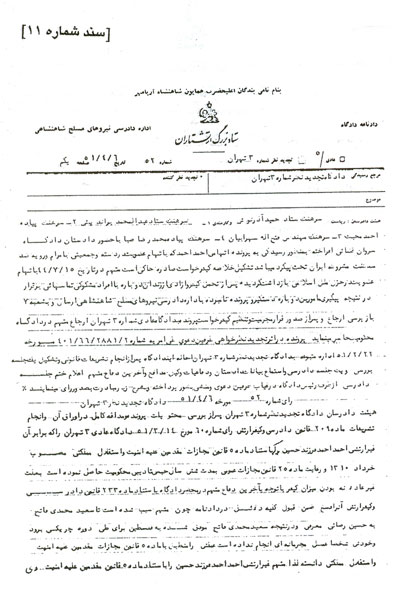
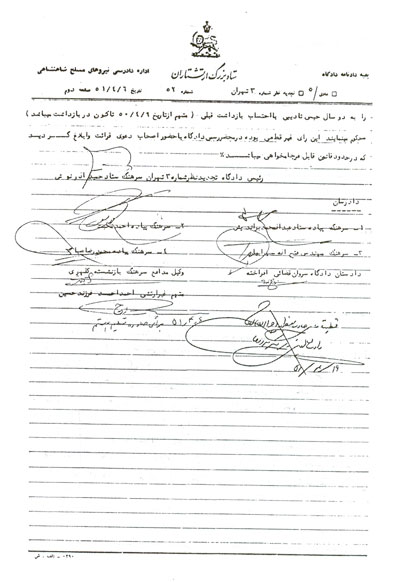
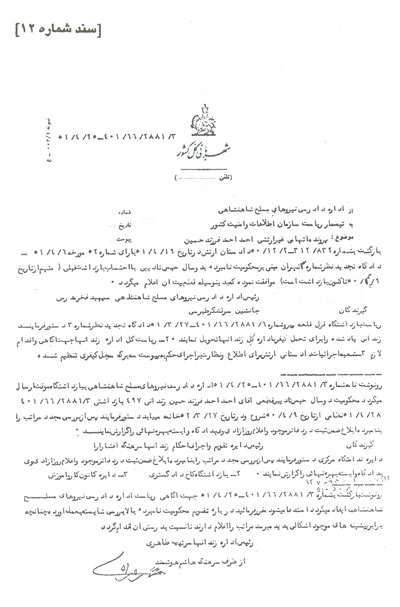
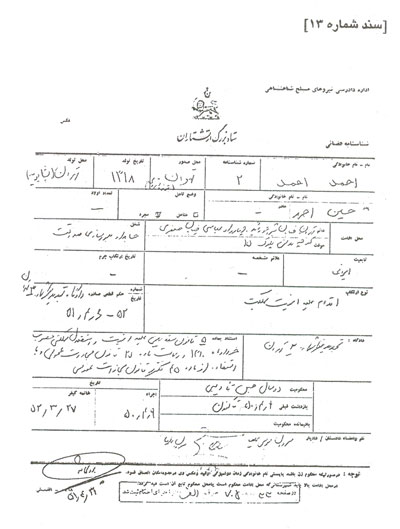
After hearing my accusation Colonel Kalhor began his so-called defense of me. He had written something quite general and I saw if I wait to see what happens by his defense, I would lose everything. So, just like the first trial I began defending myself. At the end the judge commuted the first verdict and changed the 6 years to 2 years of correctional imprisonment. (Documents No. 11, 12 &13)
Number of Visits: 6219



The latest
- Oral History and Social Resilience in Hard Times
- 100 Questions/ 34
- Third Regiment: Memoirs of an Iraqi Prisoner of War Doctor – 34
- A Review of Scientific and Operational Strategies for Overcoming the Erosion of Narrators’ Memory
- 100 Questions/ 33
- Expert Panel Session on Oral History of the Country – (Part 2)
- Memoirs of Ahmad Nabavi
- Third Regiment: Memoirs of an Iraqi Prisoner of War Doctor – 33
Most visited
- Expert Panel Session on Oral History of the Country – (Part 1)
- Oral History News/April–May 2026
- Memoirs of Majid Yousefzadeh
- Third Regiment: Memoirs of an Iraqi Prisoner of War Doctor – 33
- Expert Panel Session on Oral History of the Country – (Part 2)
- 100 Questions/ 33
- Memoirs of Ahmad Nabavi
- A Review of Scientific and Operational Strategies for Overcoming the Erosion of Narrators’ Memory
Validation: Challenges and Necessities
Where does truth stand in oral history? How can the correctness of a narrative be recognized? Does fact-checking matter? If there is exaggeration in the reporting of some accounts, how can it be detected? Is it possible to record an event accurately through the recording of a narrative? Readers and users of oral history works are often faced with these questions, and sometimes encounter doubts about some oral history works.From Revolutionary Circles to the Military Arm of the Islamic Government
In those days, it became clear that certain institutions had to be established very quickly—institutions suited to the temperament, expectations, and lingering aspirations of the younger generation; young people who had been politically active before the Revolution and, in some cases, had been directly entangled in arrests, imprisonment, ...Authenticating Oral History: From Possibility to Necessity
The use of oral history as one of the historical sources has long been one of the principal challenges facing oral historians and those who employ it in contemporary historiography. The development of international standards for oral history, as well as IRIB standards, was intended to address the criticisms raised in this regard. The relationship between Diplomatics in written records and oral history is reciprocal.100 Questions/27
What is the place of research ethics in compiling oral history?We asked several researchers and activists in the field of oral history to express their views on oral history questions. The names of each participant are listed at the beginning of their answers, and the text of all answers will be published on this portal by the end of the week.

