
Professor forms oral history course
15 May 2013
By LAUREN HINOJOSA
Staff Writer
Published: Thursday, March 21, 2013
Updated: Monday, March 25, 2013
History students have become filmmakers with the addition of an oral history course on campus.
Juniors and seniors have the opportunity to take a class in oral history and learn how to transcribe and archive history. Justin Nystrom, assistant history professor, began teaching his freshmen seminar students how to document history and has decided to make it into a course of its own.
“We’re moving into the realm of filmmaking,†Nystrom said. “I want students to be passionate about it. Have fun.â€
Amelie Karam, performance and film studies senior, worked on a documentary about the New Orleans Longshoremen and has presented the film at a recent Southern Labor Studies Association meeting. The documentary focuses on how the longshoremen’s work has changed due to new work ethics.
COURTESY OF LOYOLA UNIVERSITY OFFICE OF PUBLIC AFFAIRS
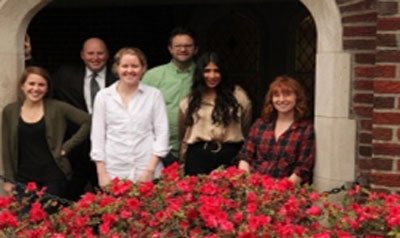
Eric Buras, Kyleah Frederic, Sheila Tahir, Amelie Karam, Caitlin Webster, and assistant history professor Justin Nystrom, Ph.D. from the Documentary and Oral History class. The class focuses on engaging students on documenting oral history through the medium of film about subjects they are passionate about.
“It’s about the men who have worked on the docks along the water front,†Karam said. “One of the main questions was about how containerization has impacted them. This made work much more efficient but changed the men’s lives greatly. The necessary men needed was cut in half."
Karam said she took the class last semester and, with the help and guidance of Nystrom, the class was a great way to learn about New Orleans and was an opportunity to be very hands on.
“The class was fun,†Karam said. “We formed a little family since we were together for three or more hours every Monday night. It was hard work, but worth it.â€
Eric Buras, political science junior, was excited to be a part of making the documentary and got a better idea of how oral history is studied and performed.
“Our class was the first oral history class taught by Dr. Nystrom, so it was a learning experience,†Buras said.
The class has only been offered in the fall but Buras plans to take the class again. Each semester, the class will have a new focus. Buras has heard the fall 2013 session will showcase the wave of entrepreneurs brought to the city since Hurricane Katrina.
“I think the class is best suited for students interested in understanding oral history, how to edit and produce documentaries, and want to learn interviewing techniques,†Buras said.
Buras said working with the longshoremen was fun but at times challenging.
“The longshoremen were a riot,†Buras said. “They’re sort of like politicians, instead of answering what they were asked they would just talk about what they wanted to.â€Caitlin Webster, history senior, enjoyed the class even though it was time consuming and working with the longshoremen was at times difficult.
“Some of the longshoremen were quiet, which made interviewing them challenging, but there were also some who were very talkative and had really interesting stories to tell,†Webster said.
Webster said the class is best for students interested in interviewing and journalism.
Kenneth Crier, president of the International Longshoremen’s Association Local 3000, is excited to get the chance to see the documentary.
“I haven’t seen it yet, but I have heard good things,†Crier said.
Lauren Hinojosa can be reached at lmhinojo@loyno.edu
Number of Visits: 4358
Share


The latest
- Narrative and the "War of Narratives" in the Era of Resistance and Imposed Wars
- Memories of Mohammad Boloori
- Call for Fundamental Questions in the Field of Oral History
- 100 Questions/49
- The Third Regiment: Memoirs of an Iraqi Prisoner of War - 49
- Jasem Ghazbanpour's narration of the first day of the war in Khorramshahr
- Memoirs of Ali Fadaei
- The Relationship Between Oral History and Biography
Most visited
- The Third Regiment: Memoirs of an Iraqi Prisoner of War - 48
- 100 Questions/48
- The Relationship Between Oral History and Biography
- Jasem Ghazbanpour's narration of the first day of the war in Khorramshahr
- Memoirs of Ali Fadaei
- The Third Regiment: Memoirs of an Iraqi Prisoner of War - 49
- 100 Questions/49
- Memories of Mohammad Boloori
100 Questions / 43
How can narrators and interviewers reach a common understanding?We asked several researchers and activists in the field of oral history to express their views on oral history questions. The names of each participant are listed at the beginning of their answers, and the text of all answers will be published on this portal by the end of the week.
Documentary Pathology of the US Embassy Documents
The Necessity of Scientific Rereading and Content Analysis of DocumentsMore than four decades have passed since the publication of the first collections of documents from the US Embassy in Tehran. However, despite the relatively easy access to this treasure trove of documents, systematic research exploitation of it has not been adequate. We still do not have a “comprehensive picture” of the content of these 11,000 documents.
100 Questions / 42
What is the importance of the narrator and interviewers shared understanding of the past in oral history?We asked several researchers and activists in the field of oral history to express their views on oral history questions. The names of each participant are listed at the beginning of their answers, and the text of all the answers will be published on this portal by the end of the week.
Validation: Challenges and Necessities
Where does truth stand in oral history? How can the correctness of a narrative be recognized? Does fact-checking matter? If there is exaggeration in the reporting of some accounts, how can it be detected? Is it possible to record an event accurately through the recording of a narrative? Readers and users of oral history works are often faced with these questions, and sometimes encounter doubts about some oral history works.
