
Documenting the service of Jewish vets of World War II
31 December 2012
December 17, 2012|By Jeff Danna, Chicago Tribune reporter
Highland Park residents Bill Harris and Albert Miller say every military veteran has a story to tell, and their goal is to capture as many of them on film as they can.
Harris, 70, and Miller, 90, are members of the Jewish War Veterans North Shore Post 29, and for the past six months they have been documenting the stories of their group's members, putting together a one-hour video for each and airing the episodes on the local cable access channel.
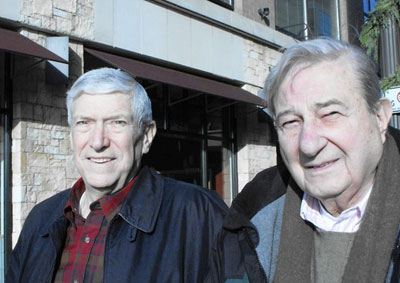
"The first six people we've done have had pretty exciting and impressive careers in the military," said Miller, a retired cardiologist and Air Force veteran. "What we'd eventually like to do is get down to the more ordinary people. That's the reality of the people in the service."
Harris and Miller said they picked up a vague idea last year among some Jewish War Veterans members and ran with it. Through Miller's connections at the local senior center, which produces cable access programming, the two were able to find a home for their project on TV.
The first interview subjects have been some of the oldest post members, such as Highland Park resident Nathan Firestone, the subject of a recent Tribune article. Firestone was a prisoner of war during World War II who, with two fellow soldiers, escaped his Nazi captors and wandered through the Alps for days before meeting up with another group of American soldiers.
Talking with Jewish veterans who fought a regime bent on eliminating their people produced some particularly poignant moments on camera, Harris said.
"Two of the six were POWs. When you listen to (Firestone), there's no doubt he knew what he was fighting," said Harris, who spent his career in the Navy, eventually becoming an architect and engineer who worked on nuclear submarines.
The goal of the project, Harris and Miller said, is to interview all 50 members of the local Jewish War Veterans post. They want to hear not just about their fellow veterans' experiences in the military but also about their lives prior and since. The task can be tricky, since some of the veterans are modest about their service, Harris said. Eventually, he added, the interviewees tend to open up and share photos and other artifacts with the episode's producers.
Harris said he and Miller hope to share their work with a wider audience.
"We're going to look for potential places to archive these," Harris said. Some organizations they are considering are the Lake County Discovery Museum, the Highland Park Historical Society and the Pritzker Military Library.
And the two men leading the project could also become part of it. "Eventually I'll interview Bill, and he may interview me," Miller said.
The oral history episodes can be seen at 9 p.m. Saturdays and 4 p.m. Mondays on Comcast Channel 19 in Highland Park, Deerfield, Highwood and Winnetka. They also can be seen on Comcast Channel 10 in Highland Park. AT&T U-Verse subscribers can find the programs by tuning to Channel 99 and finding "Highland Park" or "Highland Park Municipal" in the list of stations.
jdanna@tribune.com
Number of Visits: 4938
Share


The latest
Most visited
- The Third Regiment: Memoirs of an Iraqi Prisoner of War-51
- Encountering Oral History from a Theatrical Perspective
- A year of non-stop questioning
- 100 Questions/51
- Memories of Mrs. Jumay Ahmed Karoufi
- The Third Regiment: Memoirs of an Iraqi Prisoner of War - 52
- 100 Questions/ 52
- 374th Night of Remembrance - 3
Call for Fundamental Questions in the Field of Oral History
The Oral History of Iran website invites all researchers, experts, professors, and activists in the field of oral history to share their views and experiences with the audience on the most important questions in this field. We ask you to raise a maximum of 10 fundamental questions in the field of oral history that every researcher, interviewer, and oral history enthusiast should think about, and write an answer for each in about 200 words.100 Questions / 43
How can narrators and interviewers reach a common understanding?We asked several researchers and activists in the field of oral history to express their views on oral history questions. The names of each participant are listed at the beginning of their answers, and the text of all answers will be published on this portal by the end of the week.
Documentary Pathology of the US Embassy Documents
The Necessity of Scientific Rereading and Content Analysis of DocumentsMore than four decades have passed since the publication of the first collections of documents from the US Embassy in Tehran. However, despite the relatively easy access to this treasure trove of documents, systematic research exploitation of it has not been adequate. We still do not have a “comprehensive picture” of the content of these 11,000 documents.
100 Questions / 42
What is the importance of the narrator and interviewers shared understanding of the past in oral history?We asked several researchers and activists in the field of oral history to express their views on oral history questions. The names of each participant are listed at the beginning of their answers, and the text of all the answers will be published on this portal by the end of the week.

