
Benefits of Oral History
Written by Mahya Hafezi
Translated by Kianoush Borzouei
2024-12-23
The Oral History website, aiming to delve deeper into the challenges and details of producing oral history works or memoirs, has conducted interviews with experts and practitioners in this field. These interviews are presented to the audience as brief commentaries.
History, as one of the fundamental disciplines within the humanities, has evolved through time to adopt various forms and methodologies. Concepts such as "written history," "comprehensive history," and "oral history" exemplify these approaches. Written history relies on documents and textual sources for the analysis and composition of historical accounts, while comprehensive history seeks to integrate various sources—both written and oral. Among these, oral history, which has recently garnered significant attention, is rooted in the collection of verbal accounts, interviews, and testimonies. This approach not only complements written history but also opens new prospects for historical research.
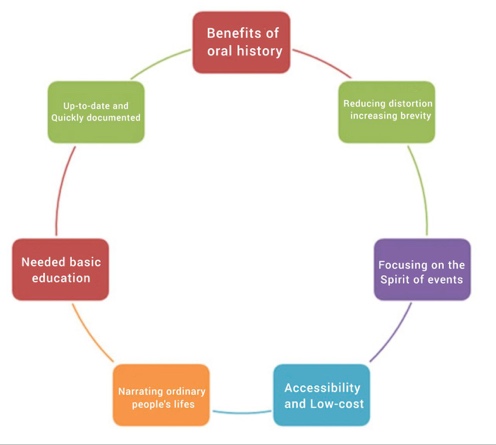
One of the most prominent advantages of oral history lies in its immediacy and contemporaneity. Unlike written history, which is often composed years after the events and delayed by the release of documents, oral history enables the immediate documentation and preservation of occurrences. This attribute allows the current generation to learn lessons from history in real time, rather than it being merely a resource for future generations.
Another significant merit of oral history is its capacity to clarify events and reduce the risk of historical distortion. Written history, primarily authored by a select group of historians long after the events have transpired, is susceptible to alteration or bias. Conversely, oral history provides the opportunity to record narratives directly from individuals who witnessed or were involved in the events themselves. This is particularly crucial when written sources are scarce or influenced by specific agendas. Oral history amplifies the voices of those often marginalized in formal historiography, offering a more inclusive and accurate portrayal of the past.
Oral history also excels in capturing details rarely found in written accounts. While written history typically focuses on overarching themes and tends to overlook the essence of events, oral history breathes life into occurrences by delving into their nuances, making them more tangible. For instance, in the case of a car accident, a police diagram may represent the written account, whereas the eyewitness testimonies unveil the incident's emotional and contextual subtleties. These details provide a profound dimension to our understanding of history, which is rarely uncovered in official records. Oral history addresses not only the "what" of events but also explores the "why" and "how," explaining the emotional and social contexts surrounding them.
Accessibility and cost-effectiveness represent additional benefits of oral history. Unlike written history, which often necessitates access to official, and sometimes restricted, documents, oral history facilitates direct dialogue with individuals present at the events. This feature enables researchers to easily gather information from witnesses without the need for elaborate and costly processes.
Oral history also distinguishes itself through its audience. Unlike written history, which predominantly recounts the lives of rulers and prominent figures, oral history narrates the experiences of ordinary individuals. By democratizing historical accounts, it extends the scope of documentation beyond elites, granting everyday people a place in the annals of history. For this reason, oral history can be suitably termed as "the people's history," presenting a mosaic of diverse and multifaceted perspectives.
On the other hand, the rapid expansion of digital media has led to an unprecedented acceleration in the circulation and production of data, posing certain challenges for oral history. While oral history’s simplicity and accessibility provide distinct advantages over written history, some incorrectly believe it requires no formal training. However, this assumption is misguided. Oral history necessitates foundational education, with practitioners gradually acquiring the required skills through experience. In contrast, producing credible written history demands years of academic study, research, and diligence. The lack of adequate training in "media literacy" can result in the dissemination of inaccurate information. To address this issue, it is vital for educational, cultural, and social systems to equip individuals with the ability to detect accurate content from misinformation, thereby ensuring the proper utilization of data.
In summary, oral history, as a novel methodology alongside written history, not only facilitates the documentation of details and events from diverse perspectives but also offers opportunities for reflection, awareness, and critical analysis of contemporary events. However, to harness the potential of this approach effectively, supervision and educational frameworks are required to guarantee the accuracy and reliability of oral narratives.
Number of Visits: 2844
Share


The latest
- Narrative and the "War of Narratives" in the Era of Resistance and Imposed Wars
- Memories of Mohammad Boloori
- Call for Fundamental Questions in the Field of Oral History
- 100 Questions/49
- The Third Regiment: Memoirs of an Iraqi Prisoner of War - 49
- Jasem Ghazbanpour's narration of the first day of the war in Khorramshahr
- Memoirs of Ali Fadaei
- The Relationship Between Oral History and Biography
Most visited
- The Third Regiment: Memoirs of an Iraqi Prisoner of War - 48
- 100 Questions/48
- The Relationship Between Oral History and Biography
- Jasem Ghazbanpour's narration of the first day of the war in Khorramshahr
- Memoirs of Ali Fadaei
- The Third Regiment: Memoirs of an Iraqi Prisoner of War - 49
- 100 Questions/49
- Memories of Mohammad Boloori
100 Questions / 43
How can narrators and interviewers reach a common understanding?We asked several researchers and activists in the field of oral history to express their views on oral history questions. The names of each participant are listed at the beginning of their answers, and the text of all answers will be published on this portal by the end of the week.
Documentary Pathology of the US Embassy Documents
The Necessity of Scientific Rereading and Content Analysis of DocumentsMore than four decades have passed since the publication of the first collections of documents from the US Embassy in Tehran. However, despite the relatively easy access to this treasure trove of documents, systematic research exploitation of it has not been adequate. We still do not have a “comprehensive picture” of the content of these 11,000 documents.
100 Questions / 42
What is the importance of the narrator and interviewers shared understanding of the past in oral history?We asked several researchers and activists in the field of oral history to express their views on oral history questions. The names of each participant are listed at the beginning of their answers, and the text of all the answers will be published on this portal by the end of the week.
Validation: Challenges and Necessities
Where does truth stand in oral history? How can the correctness of a narrative be recognized? Does fact-checking matter? If there is exaggeration in the reporting of some accounts, how can it be detected? Is it possible to record an event accurately through the recording of a narrative? Readers and users of oral history works are often faced with these questions, and sometimes encounter doubts about some oral history works.
