
Hiroshima Travelogue - Episode 7
We get off the train at Hiroshima Station. Awaiting us is a welcoming Japanese delegation at the platform. They hand each one of us a beautiful flower; we happen to care more about the small flower than our luggage.
They represent a non-profit organization (called MOCT), and will also be our host at the August-6 fete mounted in Hiroshima to mark the anniversary of the atomic bombardment.
Outside of the station, a van is waiting for us. As we take our seats, they give us round sandwiches from McDonalds. They probably know about our eating habit so far as the sandwich is stuffed with fish.
The fat driver introduces himself and the travel agency he works for; and wishes to do his job properly during the days he is responsible for taking us to different places in Hiroshima. He then asks us to fasten our seatbelts, but there are no belts. It is cool which makes it feel better under the summer sun.
He takes us to the city; but no, he takes us to the outskirts of the city. He is to take us to the Enoshima Island to visit a museum.

About an hour later, we reach the end of the road and have to keep moving through the water, by a vessel of course. We keep waiting. The nature’s view is picturesque and abounds with isles and greenery in the sea.
We get to the vessel and leave at the island. The Toxic Gas Museum is not a very big place. It has two relatively small halls; one displays the machinery and means used for producing toxic gasses and the other has seats for visitors to sit and listen.
It can be inferred from the whole establishment that the place is a confession in the Japanese style to admit the mistake they have made to create such weapons of mass destruction.
This is how the Japanese army was equipped with chemical weapons and used them in the battle zone against its enemies. The establishment has been deleted from the map by Japan but it was annihilated by US forces at the end of the Second World War in 1945. A lot of the staff were injured or killed by chemical gassed during the production procedure in the factories. The introduction sheet of the museum says that before 1984, most of the Japanese were unaware of the fact that their country was a producer of toxic gasses. It was in that year that they released the info about the gasses and the role Japan has played in their production and proliferation.
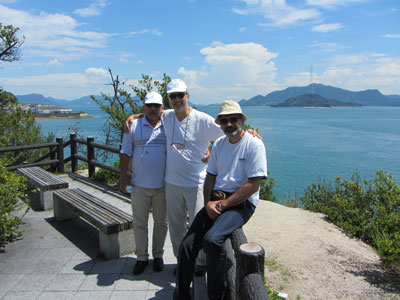
The first hall shows the remnants of toxic gas production factory. Taking pictures is forbidden in the hall. A small library is located at the other hall. I scan the titles. A photo album of Halabcheh is among the books. On the walls, beside the maps and among the photos are pictures of chemically injured Iranians. It looks like the fallouts of the decade-long transactions between Tehran Peace Museum and Hiroshima and the MOCT have reached the island. Enoshima is no more a reminiscent of bad memories; it is a vacation resort for visitors nowadays.
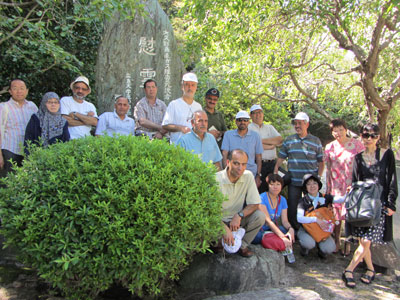
Many rabbits are set free in the island. They say rabbits are sensitive to toxic gasses and rapidly react to them. The rabbits seem serene implying that the island has been clean of the gasses for years and is a healthy resort for visitors. Rabbits represent the island, rather than toxic gasses. The picture of a rabbit is manifest at the island’s only department store. Most of the stuff are decorated with the emblem of a rabbit.
The sun and the sultry weather have kept us in the shade waiting for the vessel to take us back to where the fat driver is waiting for us. The vessel takes us along a line of cars waiting in the beach. Now they give us each an ice cream.
Hedayatollah Behboudi
Translated by Abbas Hajihashemi
Number of Visits: 5914
Share


The latest
- Narrative and the "War of Narratives" in the Era of Resistance and Imposed Wars
- Memories of Mohammad Boloori
- Call for Fundamental Questions in the Field of Oral History
- 100 Questions/49
- The Third Regiment: Memoirs of an Iraqi Prisoner of War - 49
- Jasem Ghazbanpour's narration of the first day of the war in Khorramshahr
- Memoirs of Ali Fadaei
- The Relationship Between Oral History and Biography
Most visited
- The Third Regiment: Memoirs of an Iraqi Prisoner of War - 48
- 100 Questions/48
- The Relationship Between Oral History and Biography
- Jasem Ghazbanpour's narration of the first day of the war in Khorramshahr
- Memoirs of Ali Fadaei
- The Third Regiment: Memoirs of an Iraqi Prisoner of War - 49
- 100 Questions/49
- Memories of Mohammad Boloori
100 Questions / 43
How can narrators and interviewers reach a common understanding?We asked several researchers and activists in the field of oral history to express their views on oral history questions. The names of each participant are listed at the beginning of their answers, and the text of all answers will be published on this portal by the end of the week.
Documentary Pathology of the US Embassy Documents
The Necessity of Scientific Rereading and Content Analysis of DocumentsMore than four decades have passed since the publication of the first collections of documents from the US Embassy in Tehran. However, despite the relatively easy access to this treasure trove of documents, systematic research exploitation of it has not been adequate. We still do not have a “comprehensive picture” of the content of these 11,000 documents.
100 Questions / 42
What is the importance of the narrator and interviewers shared understanding of the past in oral history?We asked several researchers and activists in the field of oral history to express their views on oral history questions. The names of each participant are listed at the beginning of their answers, and the text of all the answers will be published on this portal by the end of the week.
Validation: Challenges and Necessities
Where does truth stand in oral history? How can the correctness of a narrative be recognized? Does fact-checking matter? If there is exaggeration in the reporting of some accounts, how can it be detected? Is it possible to record an event accurately through the recording of a narrative? Readers and users of oral history works are often faced with these questions, and sometimes encounter doubts about some oral history works.
