
Nicholls seeking veterans to record war stories
20 February 2012
Matthew Albright
Staff Writer
Published: Thursday, November 17, 2011 at 11:26 a.m.
Last Modified: Thursday, November 17, 2011 at 11:26 a.m.
Nicholls State University is looking for Louisiana veterans willing to tell their stories as part of an oral-history project.
“This project affords a unique opportunity to look at the recent and remote past, both locally and globally, through the eyes of those who witnessed events worthy of a second look,” said Neil Guilbeau, an archivist at Ellender Memorial Library who is spearheading the project. “My intention is not to glorify war, but to honor those who answered the call to defend our nation and its interests since the mid 20th century.
Guilbeau is sitting down with as many veterans as he can, interviewing them about their experiences in the war. He's seeking to preserve memories of battles, hard marches and other wartime memories.
The project seeks soldiers from all branches of the military. He's also looking for soldiers to represent every possible conflict that U.S. soldiers have fought in.
So far, about 70 veterans have volunteered. A sample of some of their answers can be found on Nicholls' YouTube page.
Many of these soldiers witnessed and participated in events of huge significance, like James Womack, a World War II veteran.
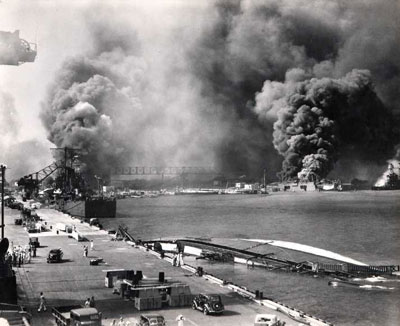
“When they bombed Pearl Harbor, we were the first large ship to make it out of the harbor,” said James Womack, who served in the U.S. Navy. “ ‘Man your battle stations! Man your battle stations! This is not a drill.' That's what we all thought it was, a drill.”
Others, fresh back from Iraq and Afghanistan, know what it's like to live in a camp in arid, hostile environments with the constant threat of attack.
“When our base camp got mortared, you could tell it was someone from near the base camp,” Ron Thibodaux said. “The spots where we congregate during the day, that's where they were hitting.”
Guilbeau said he doesn't have a political agenda in creating the work. He simply wants to tell the personal stories of what it's like to fight.
“While patriotic in its overall tone, this collection, first and foremost, seeks to portray the lives of individuals rather than political ideologies,” he said.
Once the school has amassed a significant collection, Guilbeau hopes to make the project available for public viewing via the Nicholls archives and the Louis Louisiana Library Network. He also plans to donate video copies to the Library of Congress for the National Veterans History Project.
If you or someone you know is a veteran and wants to participate, contact Guilbeau at 493-2639 or neil.guilbeau@nicholls.edu.
Staff Writer Matthew Albright can be reached at 448-7635
or at matthew.albright@
dailycomet.com.
Number of Visits: 5046
Share


The latest
- 374th Night of Remembrance - 3
- 100 Questions/ 52
- The Third Regiment: Memoirs of an Iraqi Prisoner of War - 52
- A year of non-stop questioning
- Memories of Mrs. Jumay Ahmed Karoufi
- Encountering Oral History from a Theatrical Perspective
- 100 Questions/51
- The Third Regiment: Memoirs of an Iraqi Prisoner of War-51
Most visited
- The Third Regiment: Memoirs of an Iraqi Prisoner of War-51
- Encountering Oral History from a Theatrical Perspective
- 100 Questions/51
- A year of non-stop questioning
- Memories of Mrs. Jumay Ahmed Karoufi
- The Third Regiment: Memoirs of an Iraqi Prisoner of War - 52
- 100 Questions/ 52
- 374th Night of Remembrance - 3
100 Questions / 43
How can narrators and interviewers reach a common understanding?We asked several researchers and activists in the field of oral history to express their views on oral history questions. The names of each participant are listed at the beginning of their answers, and the text of all answers will be published on this portal by the end of the week.
Documentary Pathology of the US Embassy Documents
The Necessity of Scientific Rereading and Content Analysis of DocumentsMore than four decades have passed since the publication of the first collections of documents from the US Embassy in Tehran. However, despite the relatively easy access to this treasure trove of documents, systematic research exploitation of it has not been adequate. We still do not have a “comprehensive picture” of the content of these 11,000 documents.
100 Questions / 42
What is the importance of the narrator and interviewers shared understanding of the past in oral history?We asked several researchers and activists in the field of oral history to express their views on oral history questions. The names of each participant are listed at the beginning of their answers, and the text of all the answers will be published on this portal by the end of the week.
Validation: Challenges and Necessities
Where does truth stand in oral history? How can the correctness of a narrative be recognized? Does fact-checking matter? If there is exaggeration in the reporting of some accounts, how can it be detected? Is it possible to record an event accurately through the recording of a narrative? Readers and users of oral history works are often faced with these questions, and sometimes encounter doubts about some oral history works.
