
14th International Conference on New Directions in the Humanities
University of Illinois at Chicago, Student Center East
Chicago, USA
8-11 June 2016
CONFERENCE FOCUS
The Humanities Conference is held annually in different locations around the world. Over the past twelve years, the Humanities Conference has established a reputation as a focal point for new ideas and new practices in humanities research and teaching.
The conference will address a range of critically important themes in the various fields that make up the humanities today. Plenary speakers will include some of the world’s leading thinkers in the humanities, as well as numerous paper, workshop and colloquium presentations by teachers and researchers.
We are inviting proposals for paper presentations, workshops/interactive sessions, posters/exhibits, or colloquia (See Proposal Types) addressing the Humanities through one of the following themes:
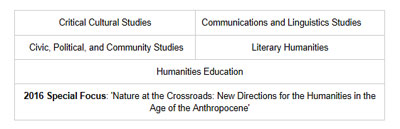
For more information about the ideas and themes underlying this community, see Our Focus.
Virtual participation is available for those who are unable to attend the conference in person. Proposal ideas that extend beyond these thematic areas will also be considered.
2016 Special Focus: 'Nature at the Crossroads: New Directions for the Humanities in the Age of the Anthropocene'
The purpose of the various fields of the humanities is to reflect on the human condition. One of the fundamental questions of our times, and one that is increasingly central to the question of our human condition, is the condition of nature. In this regard, there is a growing concern that our very species' existence is now under threat as a consequence of human activity. The age of ‘the Anthropocene’ is characterized by the blowback of a ‘great acceleration’ in human impacts upon nature: modern industry, population growth, and increasing per capita consumption. These have resulted in human-induced changes to global temperatures, sea levels, CO2 in the atmosphere, to name just a few consequential eco-systemic changes.
The special focus for the Fourteenth International Conference on New Directions in the Humanities - Nature at the Crossroads: New Directions for the Humanities in the Age of the Anthropocene - is to explore the conceptual and historical framing of the Anthropocene. How does this reconceptualization of natural history demand new approaches to the work of the humanities? How, in this frame of reference, is self positioned in relation to community and nature? What is the ontological basis of knowledge, autonomy, and freedom as interpretative perspectives on human action in the natural world? How do we read the symbolic and its distinction from or imbrication with the material? What is the unique character of human history and its contra-distinction with natural history, of geological time compared to human time? How should the humanities and the natural sciences relate to each other as we address the challenges of the Anthropocene?
SUBMIT A CONFERENCE PROPOSAL
To learn more about preparing and submitting your conference proposal, including guidelines, deadlines, and "how-to" information, go to Submitting Your Work: Conference Presentations.
CONFERENCE DETAILS
To learn more about the conference, including speakers, session formats, venue, registration, and the like, stay in The Conference section of the website and use the navigation bar on the left to access desired information.
SUBMIT YOUR PROPOSAL IN SPANISH OR PORTUGUESE
Delegates interested in submitting a proposal and presenting at the 2016 conference in either Spanish or Portuguese may submit their proposal through our partner knowledge community, Humanidades. Proposals submitted through this site will be considered for publication in the fully refereed Revista Internacional de Humanidades and will be presented in Spanish or Portuguese at the conference in a special Spanish/Portuguese-language themed session.
Number of Visits: 7866
Share


The latest
- 374th Night of Remembrance - 3
- 100 Questions/ 52
- The Third Regiment: Memoirs of an Iraqi Prisoner of War - 52
- A year of non-stop questioning
- Memories of Mrs. Jumay Ahmed Karoufi
- Encountering Oral History from a Theatrical Perspective
- 100 Questions/51
- The Third Regiment: Memoirs of an Iraqi Prisoner of War-51
Most visited
- Report of the Third Meeting of the Specialized Roundtable on Oral History of the Country
- 100 Questions/50
- Oral History News for August 23rd – September 22nd 2026
- The Third Regiment: Memoirs of an Iraqi Prisoner of War-51
- Family History; A Legacy for Future Generations
- Encountering Oral History from a Theatrical Perspective
- 100 Questions/51
- A year of non-stop questioning
100 Questions / 43
How can narrators and interviewers reach a common understanding?We asked several researchers and activists in the field of oral history to express their views on oral history questions. The names of each participant are listed at the beginning of their answers, and the text of all answers will be published on this portal by the end of the week.
Documentary Pathology of the US Embassy Documents
The Necessity of Scientific Rereading and Content Analysis of DocumentsMore than four decades have passed since the publication of the first collections of documents from the US Embassy in Tehran. However, despite the relatively easy access to this treasure trove of documents, systematic research exploitation of it has not been adequate. We still do not have a “comprehensive picture” of the content of these 11,000 documents.
100 Questions / 42
What is the importance of the narrator and interviewers shared understanding of the past in oral history?We asked several researchers and activists in the field of oral history to express their views on oral history questions. The names of each participant are listed at the beginning of their answers, and the text of all the answers will be published on this portal by the end of the week.
Validation: Challenges and Necessities
Where does truth stand in oral history? How can the correctness of a narrative be recognized? Does fact-checking matter? If there is exaggeration in the reporting of some accounts, how can it be detected? Is it possible to record an event accurately through the recording of a narrative? Readers and users of oral history works are often faced with these questions, and sometimes encounter doubts about some oral history works.
