
Book Review
The Years of Shame
Compiled by: Maliheh Kamaledin
Translated by: Fazel Shirzad
2023-2-21
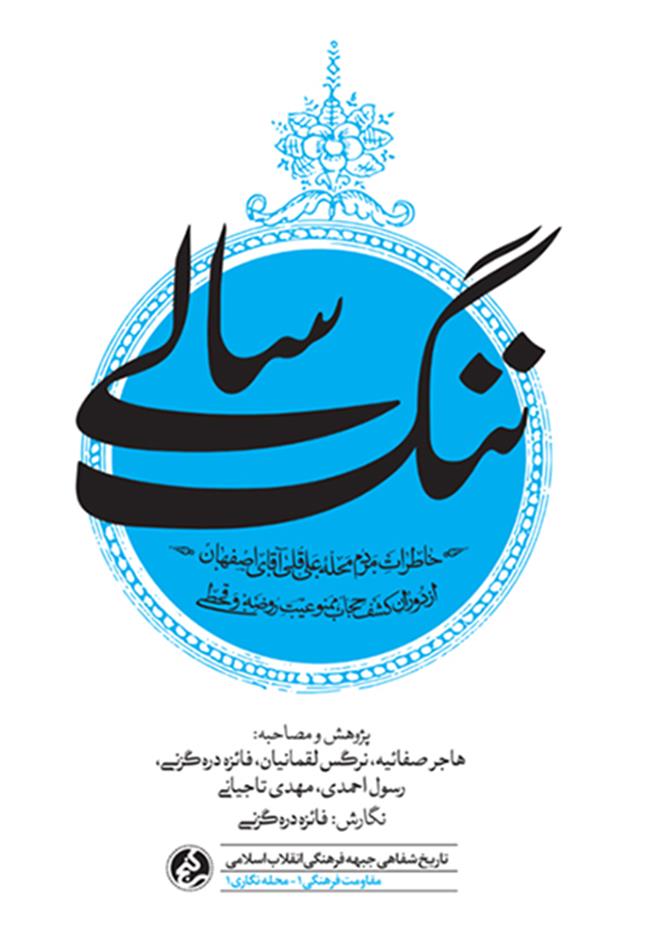
The Years of Shame is the title of the book of memoirs of the people of Ali Qali neighborhood of Isfahan from the time of the discovery of the hijab, the prohibition of the homily and the famine, which researches and interviews were conducted by Hajar Safaiyeh, Narges Loqmanian, Faeze Darehgzani, Rasul Ahmadi and Mehdi Tajiani, and it was written by Faezeh Darehgezani.
At first, the reader quickly realizes that this book has an innovative structure both in terms of form and content. The way of page layout of the book on the one hand and the choice of titles and even the font of the text are indicative of this.
As usual, the book begins with the publisher's foreword and introduction, and then, three chapters with the titles "Pardehneshin"(secluded), "Shahneshin"(tablinum) and "Khakneshin"(ground-seated) are placed in front of the reader. At the end of each chapter, a number of photos and documents are given as appendices, and at the end of the book, we also see the footnotes for each chapter.
In the foreword of the book, which was written by the oral history unit of the cultural front of the Islamic Revolution, a brief description of the uniformity of clothes, the banning of the mosque, the discovery of women's hijab, etc. at the time Reza Khan Pahlavi came to power, and the confrontation that the religious and traditional society of Iran He has called what he did with this anti-religious and decadent trend "seven years of sacred cultural defense".
The introduction of the book is written in two parts; In the first part, the writer takes the reader's mind in the Ali Qali Agha neighborhood with a narative pen and depicts the role of the people who lived there. In the second part, he gave a brief explanation of how to do the work and thanked the people who were involved in this work. In the final parts of the book's introduction, we read:
The upcoming book is written in three chapters:
-
First, the " Pardehneshin" that removes the curtain from the days of chaos and anxiety;
-
Second, "Shahneshin" which is inscriptions of secret devotions to the leader of the martyrs;
-
Third, the "Khakneshin", is talking about what happened to these people from famine and disease.
The first chapter of the book is unsaid stories from the days of discovering hijab during Reza Shah's era. In the introduction of this chapter, a historical description of the process of discovering hijab and changing clothes, which first whispers began in 1928, is given, and explanations are given about Reza Shah's clear opposition to the clerics in this regard. Since Isfahan is known as a religious and traditional city with sincere scholars and religious people, many people of this city opposed Reza Shah's actions.
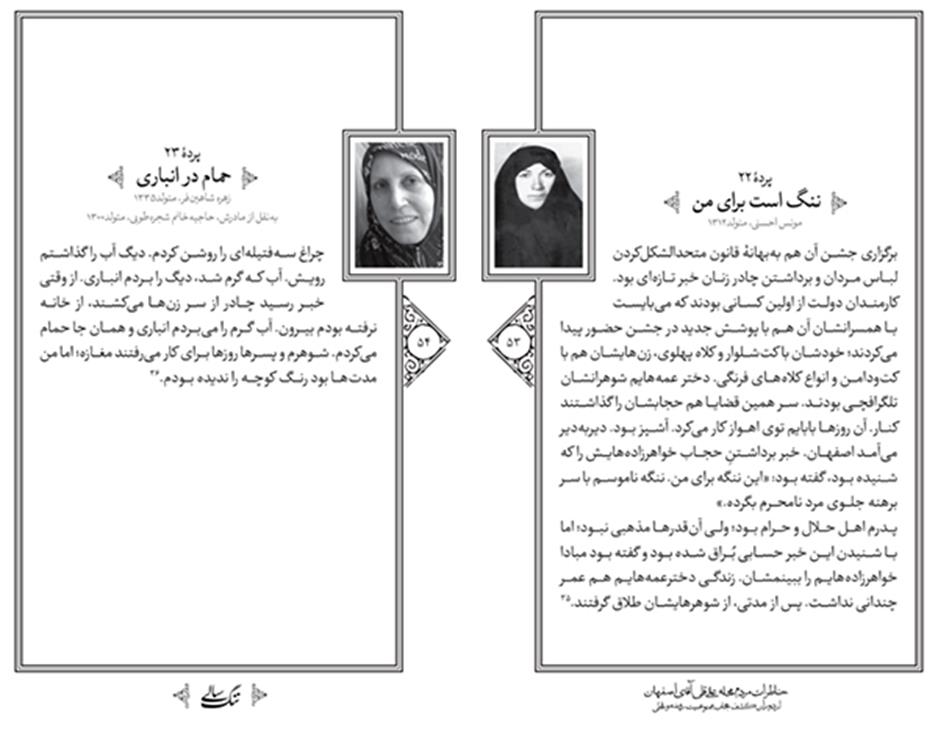
In this chapter of the book, the number of 41 narratives with the general title "curtain" from the memories of women and men of the traditional and pious neighborhood of Ali Qali Agha since the discovery of the hijab are given. Some of these memories are related to the narrator himself, and some others have been narrated by the narrator's mother, father or grandmother.
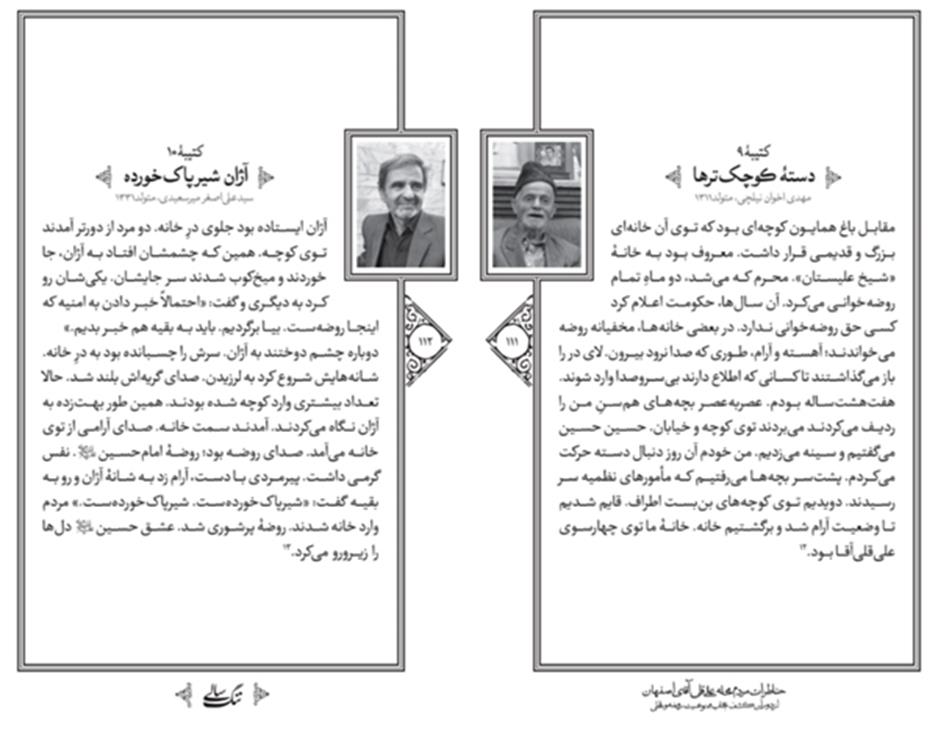
After reaching the throne, Reza Shah started breaking the sanctity of Muharram and Safar with his policies and tactics. First, traditional ceremonies such as Ta'ziyya and homliy were banned, and in the next stage, the restriction and prohibition of mourning groups and disrupting the glory of Ashura manifestations and making fun of it were done. The second chapter of book the Years of the Shame deals with unsaid stories from the days of the prohibition of fasting. In this chapter, 14 narrations with the general title "Inscriptions" are given about the secret devotion of the people of Ali Qali Agha neighborhood to Seyyed al-Shahada (PBUH) at a time when it was forbidden to read his name and remember him.
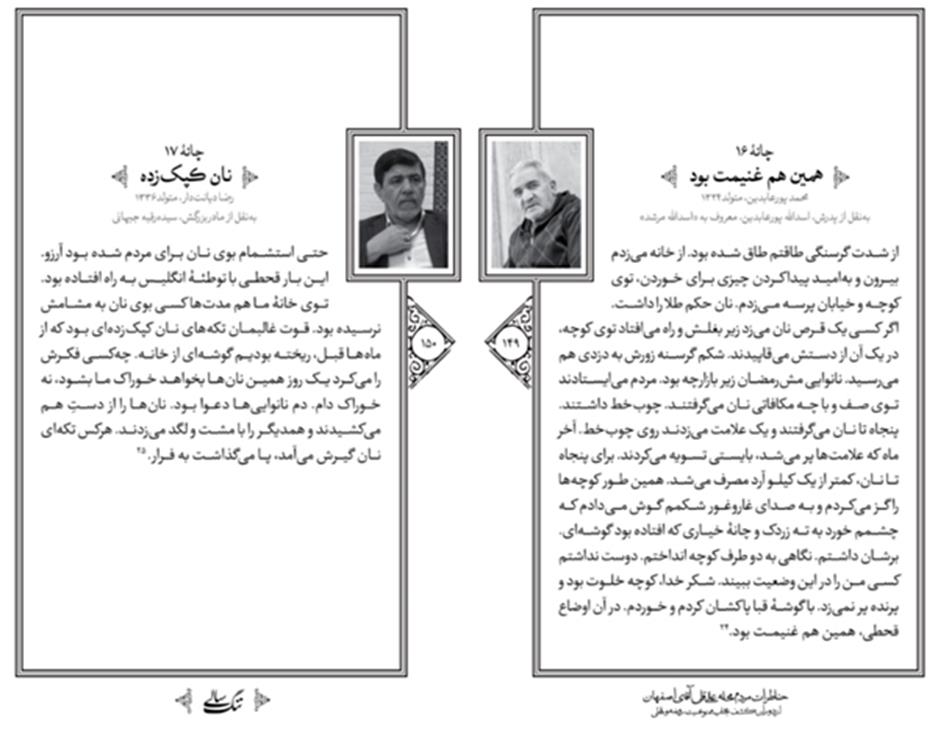
In Iran, famine hit the people three times. It happened for the first time in the year 1871 to 1872 during the time of Naser al-Din Shah Qajar, which was the main cause of the imprudence of the king along with consecutive droughts and lack of rain. The second time was in 1296 to 1298 AD at the same time as the First World War, which became known as the year of “Maja’a” or “Dempakhtaki”[1]. The third time was in the years 1942 to 1946 and coincided with the Second World War, and this time it was not the drought and the lack of rain, but the political and social disorder of the country and the occupation of Iran by the Allies that were the main factors. The third chapter of the book is unsaid from the days of famine and sad writings from the memories of these years that the people of Ali Qoli Aghai neighborhood of Isfahan went through. In this chapter, there are 24 narrations with the general title of “Chane”.
The first edition of book The Years of Shame with 184 pages, number of 1000 copies and price of 40 thousand Tomans was published in 1401 by Rahyar Publications. Also, the electronic version of this book has been made available to those interested by the Taqcheh reading platform at a price of 15 thousand Tomans.
[1] Rasul Jafarian and Fereshte Koushki, “Tanbiyeh al-Ghafilin and Ibrallal-Nazarin in the Famine of Isfahan”, Payam Baharestan, Vol. 1, No. 3, Spring 2008, p. 132.
Number of Visits: 4696



The latest
- Preparing a report for Khorasan Radio and Television
- 100 Questions/47
- The Third Regiment: Memoirs of an Iraqi Prisoner of War - 47
- Servants Narration of the Religious Rituals of the Holy Shrine of Imam Reza (AS) From Tradition to Lived Experience
- Memories of Nasrollah Fat’hian
- Memories of Hossein Ali Najafian
- 100 Questions/46
- The Third Regiment: Memoirs of an Iraqi Prisoner of War - 46
Most visited
- 100 Questions/ 45
- Theory Six: The Inevitability of Perspective
- Memoirs of Behzad Rastegari
- The Third Regiment: Memoirs of an Iraqi Prisoner of War - 46
- 100 Questions/46
- Servants Narration of the Religious Rituals of the Holy Shrine of Imam Reza (AS) From Tradition to Lived Experience
- Memories of Nasrollah Fat’hian
- Memories of Hossein Ali Najafian
100 Questions / 43
How can narrators and interviewers reach a common understanding?We asked several researchers and activists in the field of oral history to express their views on oral history questions. The names of each participant are listed at the beginning of their answers, and the text of all answers will be published on this portal by the end of the week.
Documentary Pathology of the US Embassy Documents
The Necessity of Scientific Rereading and Content Analysis of DocumentsMore than four decades have passed since the publication of the first collections of documents from the US Embassy in Tehran. However, despite the relatively easy access to this treasure trove of documents, systematic research exploitation of it has not been adequate. We still do not have a “comprehensive picture” of the content of these 11,000 documents.
100 Questions / 42
What is the importance of the narrator and interviewers shared understanding of the past in oral history?We asked several researchers and activists in the field of oral history to express their views on oral history questions. The names of each participant are listed at the beginning of their answers, and the text of all the answers will be published on this portal by the end of the week.
Validation: Challenges and Necessities
Where does truth stand in oral history? How can the correctness of a narrative be recognized? Does fact-checking matter? If there is exaggeration in the reporting of some accounts, how can it be detected? Is it possible to record an event accurately through the recording of a narrative? Readers and users of oral history works are often faced with these questions, and sometimes encounter doubts about some oral history works.
