
Oral History Workshop – 1
General features
Shahed Yazdan
Translated by M. B. Khoshnevisan
2022-12-6
The oral history website is going to provide the educational materials of some oral history workshops to the audience in written form. The present series has been prepared using the materials of one of these workshops. As you will see, many of the provided contents are not original or less said contents, but we have tried to provide categorized contents so that they can be used more.
Introduction
This educational series includes four sections of general features, interviews, editing and book engineering. Definitions of words and terms will be discussed in general features. Also, the rules, regulations, and requirements of oral history are raised and discussed in this section.
Since oral history interviews are based on the collection of raw materials, the second part of the series will be dedicated to this topic. In this section, the tasks that the interviewer is responsible for before, during and after the interview, will be included to determine the characteristics and requirements of a good interview.
After the end of the interview, the raw text is ready, but this text should be developed and edited; In the third part, we will discuss editing. What is editing and what actions should be taken at this stage, as well as different editing patterns, the difference between oral history and memoirs, and other such things, will be discussed in this section.
The final stage is the text's printing and publishing; in this section, we will talk about book engineering. Things like how to choose the name of the book, cover design, introduction, text, appendices, how to print, etc. will be discussed.
General features
This section is one of the most important parts of the discussion. The definition of vocabulary and idioms have been included in this section.
Today, history has been defined as "social experiences" and some define it as "story of social experiences". But when we talk about oral history, this definition turns into "individual experiences". The important issue is that there is no doubt that history must be "documented". There are different definitions for oral history in academic debates, but what is the primary basis of this series discussion is that oral history is firstly "history", so it must be documented, and secondly, it is "oral", that is, its input and raw materials is oral materials; so, if a history is written based on oral materials, it can be called oral history.
For instance, we can refer to the recorded materials of war radios, eavesdropping of the enemy in war, people's conversations with each other, films and sounds left over from the war as oral materials. Oral history is a history whose input is oral materials, but the majority of these materials is what comes out of the narrator's tongue. Since this process is done by the method of interviewing, the importance of interview in oral history becomes clear.
The best way to collect memoirs is to interview; but not all of what the narrator says in an interview are necessarily suitable for oral history. In order to see what parts of the interview are suitable for oral history, we need to know what the people say when we interview them. By examining people's conversations, it is clear that each person expresses three things in their conversations: memoirs, analysis or knowledge.
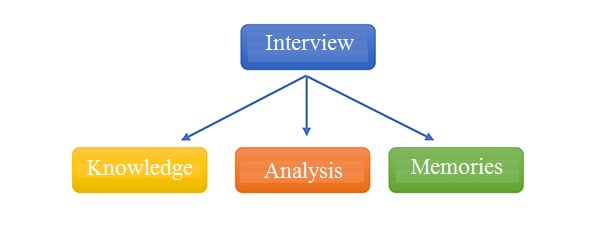
Knowledge is what we already know and does not add anything to our knowledge. For example, on 22nd of Bahman 57 (February 11, 1979), the Islamic Revolution became victorious, or on 31st of Shahrivar 59 (September 22, 1980), the war began. The knowledge exists in other sources and the interviewer does not ask such things from the interviewee. The knowledge are the most useless items in oral history. One of the problems of the interview is that the narrator is interested in expressing what he knows, while this knowledge is not useful for oral history work.
The second thing that is expressed in the interview by the narrator is analysis. For example, an event has happened and the narrator expresses his analysis about it. In some cases, the analysis is suitable for oral history, and in some cases, it is not.
The third thing that the narrator expresses in his words is memory. If the memory is fully expressed, it is suitable for oral history. The more cleverly the interviewer acts and receives more memories from the person, the more complete and better work will be produced.
|
Different parts of an Interview |
Memories |
It is useful for oral history 100%
|
|
Analysis |
Under conditions, it will help us in producing oral history work. |
|
|
Knowledge |
It is not useful for oral history at all!
|
This is while when people are interviewed, they first talk about knowledge, and then analysis and least of all, memoirs; for this reason, only ten minutes of an- hour interview may contribute to oral history work. The art of the interviewer shows itself here in how to interview and what questions to ask so that the other party expresses his memories and not his knowledge and analysis. The important point is that memoirs is different from oral history, although we use memory in oral history. This discussion will be explained in the following sections.
Number of Visits: 3902
Share


The latest
- Narrative and the "War of Narratives" in the Era of Resistance and Imposed Wars
- Memories of Mohammad Boloori
- Call for Fundamental Questions in the Field of Oral History
- 100 Questions/49
- The Third Regiment: Memoirs of an Iraqi Prisoner of War - 49
- Jasem Ghazbanpour's narration of the first day of the war in Khorramshahr
- Memoirs of Ali Fadaei
- The Relationship Between Oral History and Biography
Most visited
- The Third Regiment: Memoirs of an Iraqi Prisoner of War - 48
- 100 Questions/48
- The Relationship Between Oral History and Biography
- Jasem Ghazbanpour's narration of the first day of the war in Khorramshahr
- Memoirs of Ali Fadaei
- The Third Regiment: Memoirs of an Iraqi Prisoner of War - 49
- 100 Questions/49
- Memories of Mohammad Boloori
100 Questions / 43
How can narrators and interviewers reach a common understanding?We asked several researchers and activists in the field of oral history to express their views on oral history questions. The names of each participant are listed at the beginning of their answers, and the text of all answers will be published on this portal by the end of the week.
Documentary Pathology of the US Embassy Documents
The Necessity of Scientific Rereading and Content Analysis of DocumentsMore than four decades have passed since the publication of the first collections of documents from the US Embassy in Tehran. However, despite the relatively easy access to this treasure trove of documents, systematic research exploitation of it has not been adequate. We still do not have a “comprehensive picture” of the content of these 11,000 documents.
100 Questions / 42
What is the importance of the narrator and interviewers shared understanding of the past in oral history?We asked several researchers and activists in the field of oral history to express their views on oral history questions. The names of each participant are listed at the beginning of their answers, and the text of all the answers will be published on this portal by the end of the week.
Validation: Challenges and Necessities
Where does truth stand in oral history? How can the correctness of a narrative be recognized? Does fact-checking matter? If there is exaggeration in the reporting of some accounts, how can it be detected? Is it possible to record an event accurately through the recording of a narrative? Readers and users of oral history works are often faced with these questions, and sometimes encounter doubts about some oral history works.
