
I want to learn Farsi!
Mohammad Mehdi Abdullahzadeh
Translated by M. B. Khoshnevisan
2017-11-21
Abu Ahmad blocked our way near the evening of Monday 15th of Aban 1396 solar hijri calendar (November 6, 2017) in Najaf-Karbala road. As a matter of fact, three others had already asked us to become their guests. All of them said one thing, “Taking a shower, WiFi, a place for sleeping and taking a rest” which we had not accepted. But this last one treated us in a way that we could not accept his request.
I asked, “Is your house near or far?” He said, “It’s near but I’ve got a car.” I and the two women who were with me accompanied him. After a few steps, he bent down, got the backpack of one of our companions to carry it. After walking some fifty meters, we reached to his car. It was a new and stylish car. I said, “It’s a good car. How much did you buy it?” he said, “Two thousand dollars.” I said, “What is your job?” He answered that he was a builder. Then he asked my job that I answered: I am retried. He nodded. Apparently, he felt sorry for me. (I understood this later, because it was discovered that in Iraq, a small amount is given to a retired person every six months and thus, wage earners are forced to work until the age of sixty or seventy.)
His house was about five meters wide, but everything was designed and accurate. The yard was about one and a half meters long, with a bathroom and washbasin on the corner. There was a room with about three meters and a half at five meters for men, and a corridor for other parts of the house was originally located. Two of my female companions were led to the inner part of the house, and I went to the outer part.
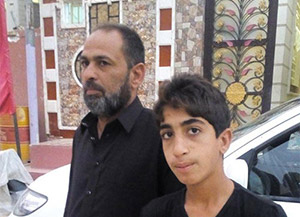
Abu Ahmad and his son
As soon as I sat down, the landowner asked me to take a shower or rest until he looks for more pilgrims. Two sons of the landowner stayed with me. One of them went and brought a jar of drinking water that I drank four glasses of it successively. As soon as I pulled out my socks, Ahmad who was twelve or thirteen years old, with an attack, grabbed it from me to take and wash it. It was useless to resist and he knew his job very well. As I was changing my shirt, the older and blind brother of Abu Ahmad came in. The children of Abu Ahmad kissed the hands of their uncle. They greeted, put a pillow for him and made him seat. I went to the bath with Ahmad’s direction. It was a hot and clean bath and relieved my tiredness. When I came back to the room, Abu Ahmad entered with another three-person group and at the same time excused us to leave and bring more guests. These friends were from Mashhad and were working in Mashhad’s bazar and thus familiar with Arabic local language. I told them that God had sent you that I could interview Ahmad better.
After a short time, Abu Ahmad came back with three more pilgrims. They lived in Tehran. One of them was an engineer and his uncle a shopkeeper and the job of his uncle’s son was in relation with construction. All of us drank Iraqi tea which was strong.
Abu Ahmad told us, “Do you eat dinner first or take a shower?” The friends preferred to take a shower first. Everyone who came back from the bath, Ahmad took his dresses to wash them by the washing machine. I started talking with Abu Ahmad.
In response to a question, Abu Ahmad said, “We are brothers with each other since old times, but Saddam launched fratricide by starting the war. If a young man did not go to the war, fist his family was beheaded before his eyes and then he was shot too. Travelling was banned under Saddam. Everybody gathered, smoked and drank tea. Ayatollah Hakim has served a lot. Every year, we prepare to receive the Arba’een pilgrims since the third day of the lunar month of Safar by launching Moukebs (special tents for entertaining the pilgrims) and providing supplies. After the day of Arba’een, forty percent of the Moukebs are closed and the Moukeb owners and some people start walking from Najaf toward Karbala. Every year, we are engaged in the Arba’een ritual for the whole two months and I proud of it. You see that all our streets and alleys are dirt, we do not have gas pipelines and even buy water, but our priority is Imam Hussein (PBUH). After this trip, every day we save money from our income for Arba’een of the next year, so that we will not be ashamed at Arba'een. Abu Ahmad took out his cellphone device and one of the brothers who was from Mashhad read a text inside it and translated into Farsi. The story was as follows, “On the Najaf route to Karbala and among the various flags carried by the walking pilgrims of the holy shrine of Imam Hussein (PBUH), a French flag attracted the attention of everyone. When they went to the flag, saw that a Christian woman from France was carrying it. When she was asked her about going to the pilgrimage of Imam Hussein (PBUH), she said, "I joined the coalition voluntarily during the invasion of Iraq. At one of the rituals of Arba'een Imam Hussein (AS), I asked one of the pilgrims who went to Karbala on foot, “Would you not get tired of going from Basra to Karbala on foot? “ She said, “I have a request from God and go there to ask it under the dome of the holy shrine of Imam Hussein (PBUH) and I am sure that God fulfill my request for the sake of Imam Hussein (PBUH).” I was diagnosed with breast cancer and doctors told me that as soon as I arrived in France, I had to give up to removing my breast in an operation. On that day, I vowed if I was healed from the disease, I would go to visit the holy shrine of Imam Hussein (PBUH) on foot from Najaf to Karbala. When I went to France, the doctors put me under medical examinations and new tests again, but surprisingly, they did not see any trace of the disease in me. Now that you see me among the walking pilgrims, in fact I’ve come to pay my vow.”
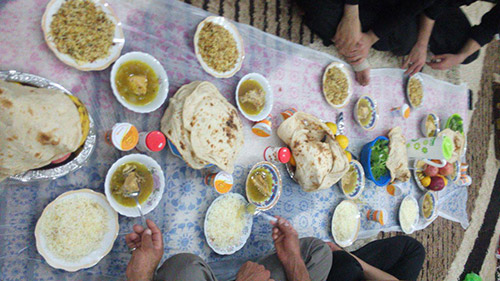
After one or two hours, it was dinner time. We were served by delicious foods like rice, salad, yoghurt and fruits. After dinner, I suggested the friends to continue walking at 4 AM but it was not agreed and we were supposed to move at 5 AM after saying prayers especially when Abu Ahmad asked us to be at his service for breakfast.
At the end of the night, Abu Mohammad brought a paper and pencil for me to write some of the most commonly used sentences in Farsi. He said he likes learning Farsi to be able to better serve the pilgrims. I told him to come to Iran to teach him Farsi.
We were served with local cream and jam in the morning. Given I had said the night before that I had a pistachio orchard, I gave him a bag of pistachio as a gift and said, “This is a product of my own orchard. I also gave my telephone number to call me whenever he comes to Iran to be at his service. Then by his car, he first took the Tehrani brothers to the walking path, and then me and my companions. I said goodbye to him and his children and took a memorial photo. His wife also came to see off the two ladies who accompanied me.
Number of Visits: 6564



The latest
- Memoirs of Mohammad Kazem Taqavi
- Theory Two: The Borderline Legitimacy Crisis of Oral History in the Academic System
- 100 Questions/ 31
- Third Regiment: Memoirs of an Iraqi Prisoner of War Doctor – 31
- 100 Questions/ 30
- The Story of a Street Classroom
- Validation: Challenges and Necessities
- Memories of Mr. Jalal Setareh
Most visited
- Theory One: “The Structural Duality of Opportunity–Threat in the Government’s Entry into Oral History”
- 100 Questions/ 29
- Memories of Mr. Jalal Setareh
- Third Regiment: Memoirs of an Iraqi Prisoner of War Doctor – 30
- Validation: Challenges and Necessities
- 100 Questions/ 30
- The Story of a Street Classroom
- Third Regiment: Memoirs of an Iraqi Prisoner of War Doctor – 31
100 Questions/27
What is the place of research ethics in compiling oral history?We asked several researchers and activists in the field of oral history to express their views on oral history questions. The names of each participant are listed at the beginning of their answers, and the text of all answers will be published on this portal by the end of the week.
Photo Album from The Doctor of fly
The Doctor of fly, authored by Fatemeh Dehghan Niri, presents the memoirs of Dr. Mohammad-Taqi Khorsandi Ashtiani, Professor Emeritus and a subspecialist in Otolaryngology at Tehran University of Medical Sciences. Compiled within the framework of oral history, the work recounts different stages of his life—from childhood and years of ...The Beating Pulse of a Nation at the Moment of Nowruz
Every year, in the days and nights leading up to Nowruz, Shohada Square had a special charm. A few days before the New Year, the shops would fill with customers, and street vendors would take over the sidewalks. You could find everything in their stalls (from items for the Haft Sin table, candles, goldfish, and spring flowers to clothes, bags, and shoes).The Editor's Missing Place on the “Deck”
The book From Deck to Heaven offers a relatively fresh approach to examining the role of the Islamic Republic of Iran Army Navy (AJA) during the eight years of the Sacred Defense, published under the “Oral History of the Islamic Revolution” series. To compile this book, the esteemed author has utilized documentary research (referring to relevant archival centers and selecting documents) and field research ...
