
Imam Khomeini
Compiled by: Islamic Revolution Website
Translated by: Fazel Shirzad
2024-8-29
Every time there was a message from Imam Khomeini, the people who followed their broadcasting, quickly found people like me to write the message on the screen or placard for them. On the same day when this order of the Imam arrived from Paris, one of the same comrades hurriedly came to the shop in the evening and said that a message from the Imam had just reached us. We want to write this on the screen tonight. He had written the text of the message on a white paper and brought placard. I said: "What is the message?" He said: "The Imam's order is about the escape of the soldiers." It was an important message; It had to be written at night because I had seen him before in the marches and knew him. I said: "Nothing. Do you know a safe place to write it?" He said: "my house." There we made an appointment to leave after dark at 8:00 PM. I went at night, bought an eight-kilogram gallon of white paint and waited. Later on, the same person followed me with his car and we started moving. On the way, we started talking about the state of the revolution. When we went a bit, I saw the car turn towards Mohammadrezashah Street, which is adjacent to the army barracks, and most of the houses in that area belong to the soldiers. I was afraid for a moment and doubted how a revolutionary person dared to live in the middle of so many military houses. I didn't know him very well, so I was afraid that it might be a trick. The car turned from "Soldier" street into one of the side streets and braked in front of a house. The house we entered had a large yard full of trees. I think there was no one else there except the two of us. Around ten o'clock at night, two of us put the placard on the yard wall and I started writing with the little light that was in the yard.
The length of the placard was twenty meters and its color was red. The red color of the placard made it difficult for me, because I had to work the white color thickly so that the line would show itself. That night, I wrote the text on the curtain once, and because the weather was cold, we waited for an hour for the curtain to dry. Then I painted another hand again. As I was writing, I got curious and asked, "Where are you going to install the placard?" He said: "It is not clear. We will install it somewhere in the street." Even though he knew me and came to look for me himself, he was still cautious and did not give detailed information. At the end of the work with the curtain, he said: "It is possible that we will put the placard inside the Pahlavi courtyard before sunrise." When he said this, I wondered how they were going to close the placard in the shrine. I finished writing on placard around one o'clock in the morning and because I was tired, I didn't wait for the curtain to dry completely, I returned home and did not understand how they were going to install the curtain in the shrine.
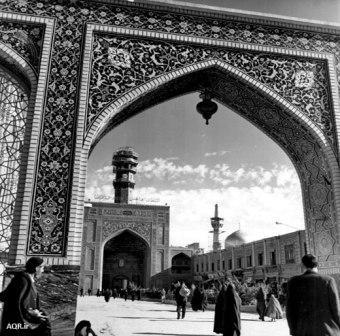
The next day, before noon, I went to the shrine to see what they had done. When I entered the Pahlavi courtyard, I saw that the placard of the Imam's message was placed near the "Dar al-Zahd" hall, above the Pahlavi courtyard. When people entered the hall, they were surprised when they saw the curtain and looked at each other, who dared to put this curtain up there? I'm laughing. No one knew who installed that curtain here. I thought that the comrades had deliberately put the placard in the side yard so that the eyes of the officials of the shrine would fall on it. Because the office of the vice-chancellor was located above the courtyard, and many important figures used to go to Dar al-Zahd from there whenever they came to the shrine. This work of the children made a lot of noise and once the news broke like a ball in Mashhad. Pilgrims of the shrine, who saw the message, would certainly go and spread the word in their own city and could spread this news to all of Iran. This was the most important placard that I wrote about Imam's messages and it was installed at night.[1]
[1]Source: Color Revolution, Alireza Khaleghi's oral memoirs, edited by Hassan Soltani, Qom, Supreme Leader's Representative Institution in Universities, Cultural Front of the Islamic Revolution, 2014, pp. 108-110.
Number of Visits: 2049
Share


The latest
- Jasem Ghazbanpour's narration of the first day of the war in Khorramshahr
- Memoirs of Ali Fadaei
- The Relationship Between Oral History and Biography
- 100 Questions/48
- The Third Regiment: Memoirs of an Iraqi Prisoner of War - 48
- Seventh Theory: The evolutionary duality of document and narrative
- Memories of Davoud Molaei
- Preparing a report for Khorasan Radio and Television
Most visited
- Preparing a report for Khorasan Radio and Television
- The Third Regiment: Memoirs of an Iraqi Prisoner of War - 47
- 100 Questions/47
- The Third Regiment: Memoirs of an Iraqi Prisoner of War - 48
- Memories of Davoud Molaei
- Seventh Theory: The evolutionary duality of document and narrative
- 100 Questions/48
- The Relationship Between Oral History and Biography
100 Questions / 43
How can narrators and interviewers reach a common understanding?We asked several researchers and activists in the field of oral history to express their views on oral history questions. The names of each participant are listed at the beginning of their answers, and the text of all answers will be published on this portal by the end of the week.
Documentary Pathology of the US Embassy Documents
The Necessity of Scientific Rereading and Content Analysis of DocumentsMore than four decades have passed since the publication of the first collections of documents from the US Embassy in Tehran. However, despite the relatively easy access to this treasure trove of documents, systematic research exploitation of it has not been adequate. We still do not have a “comprehensive picture” of the content of these 11,000 documents.
100 Questions / 42
What is the importance of the narrator and interviewers shared understanding of the past in oral history?We asked several researchers and activists in the field of oral history to express their views on oral history questions. The names of each participant are listed at the beginning of their answers, and the text of all the answers will be published on this portal by the end of the week.
Validation: Challenges and Necessities
Where does truth stand in oral history? How can the correctness of a narrative be recognized? Does fact-checking matter? If there is exaggeration in the reporting of some accounts, how can it be detected? Is it possible to record an event accurately through the recording of a narrative? Readers and users of oral history works are often faced with these questions, and sometimes encounter doubts about some oral history works.
