
Interview with “Hamid Hessam”, life & authorship
Mohammad Ali Fatemi
Translated by Natalie Haghverdian
2019-12-3
"In Search of Moonlight: The Life and Writing of Hamid Hesam" is the name of an interview book by Hussein Qarai. This 175-page book, Question and Answer compiled by Shahid Kazemi, is published in the Fall of 1989.
The book begins with a list, mostly of cultural prominent features and celebrities. Their names have become headlines for Hussein Qarai's interview with Hamid Hussam, as the interviewee has spoken about them. Next to the list are two pages titled "Yearbook, Bibliography and Titles". The short introduction of Hamid Hesam, born in Hamadan in 1961 until 1398, when he became the scientific secretary of the first Book of Defenders of the Shrine (Hamedani Martyr Award). In the meantime, his military service, veteran, education and cultural activities in the field of sacred defense, particularly writing, are also included.
In the preface of the book, Hossein Qarai wrote that "In Search of the Moonlight" is the result of five detailed sessions with Hamid Hussam, one in Hamedan and three in Tehran and once on the phone ... and these fiver interviews took place in about three months. "The content following the introduction is the interview with Hamid Hessam starting with "Life and Writing". Obviously the content presents his life, his books, writing methodology and prose, and his perspective on writing about the Holy Defense, and about the writers and researchers of the Holy Defense.
Hessam's narrations in response to the questions both refer to specific moments in his life – which might be interesting both for those who know him and for those who are new to this book- and his view of the subject and the people, which might be of interest and good for study for different audiences. Anyhow, his narrations open the floor for the audience for yet another direct or indirect interaction.
Take an example of his remarks, quoted on pages 96 and 97 of "In Search of Moonlight: The Life and Authorship of Hamid Hesam": "Many people consider editing [the diary] to be the arrangement of narrator’s data. They say, if you include everything and transform the colloquial language of the narrator into a formal language then editing is complete. This is very much the case in our books ... but I believe I was probably the first person to bring the word "writing" after "editing" into my books. I write: "Interviewing, editing, and writing." Writing is other than editing. That is, editing is the formulation of the mechanical structure and arrangement of the narrator's data. Writing is reviving the stories unsaid which are forgotten in time and the writer dives somehow into the narrators mind to bring them to life. How? That's why I have to write someone whom I not only know, but I have to live with ... I strongly believe in three elements [in writing after editing]: 1. Dialogue. 2. Spatialization that is concrete and tangible expression of time and place; and 3. Imagery that is showing the interactions and reactions of people in the face of events. "
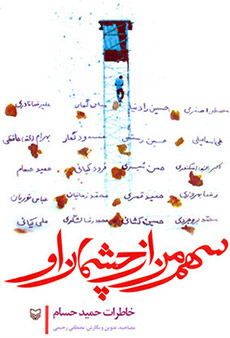
The phrases "Interviewing, editing and writing" that Hamid Hassam uttered reminded him of the book "My Share of His Eyes: Memories of Hamid Hassam". Alongside the name of Mustafa Rahimi, the same phrase manifests as his responsibility to create the book. This book was prepared in the Office of Sustainability Studies and Literature of Alborz Province and was first published in 2012 by Sureh Mehr Publications. By the fall of 2018, the third edition had been published.
"My Share of His Eyes" includes Hamid Hassam's memoirs of his presence on the sacred defense fronts, in other words his observations of Iraq's imposed war on Iran and his role in the fronts to counter Saddam's aggression. "In Search of Moonlight" is seven years away from this book. If the audience has read "My Share of His Eyes" the new book, introduces other aspects of the narrator's character which are mainly based on his viewpoint. If a reader first reads "In Search of Moonlight," he can refer to "My Share of His Eyes" to identify the source that had the greatest impact on Hamid Hussam's life and personality.
Number of Visits: 5279
Share


The latest
- Encountering Oral History from a Theatrical Perspective
- 100 Questions/51
- The Third Regiment: Memoirs of an Iraqi Prisoner of War-51
- Family History; A Legacy for Future Generations
- Oral History News for August 23rd – September 22nd 2026
- Report of the Third Meeting of the Specialized Roundtable on Oral History of the Country
- 100 Questions/50
- The Third Regiment: Memoirs of an Iraqi Prisoner of War - 50
Most visited
- Narrative and the "War of Narratives" in the Era of Resistance and Imposed Wars
- The Third Regiment: Memoirs of an Iraqi Prisoner of War - 50
- Report of the Third Meeting of the Specialized Roundtable on Oral History of the Country
- 100 Questions/50
- Oral History News for August 23rd – September 22nd 2026
- Family History; A Legacy for Future Generations
- The Third Regiment: Memoirs of an Iraqi Prisoner of War-51
- Encountering Oral History from a Theatrical Perspective
100 Questions / 43
How can narrators and interviewers reach a common understanding?We asked several researchers and activists in the field of oral history to express their views on oral history questions. The names of each participant are listed at the beginning of their answers, and the text of all answers will be published on this portal by the end of the week.
Documentary Pathology of the US Embassy Documents
The Necessity of Scientific Rereading and Content Analysis of DocumentsMore than four decades have passed since the publication of the first collections of documents from the US Embassy in Tehran. However, despite the relatively easy access to this treasure trove of documents, systematic research exploitation of it has not been adequate. We still do not have a “comprehensive picture” of the content of these 11,000 documents.
100 Questions / 42
What is the importance of the narrator and interviewers shared understanding of the past in oral history?We asked several researchers and activists in the field of oral history to express their views on oral history questions. The names of each participant are listed at the beginning of their answers, and the text of all the answers will be published on this portal by the end of the week.
Validation: Challenges and Necessities
Where does truth stand in oral history? How can the correctness of a narrative be recognized? Does fact-checking matter? If there is exaggeration in the reporting of some accounts, how can it be detected? Is it possible to record an event accurately through the recording of a narrative? Readers and users of oral history works are often faced with these questions, and sometimes encounter doubts about some oral history works.
