
The Lack of Attention to the Types of Utilization in Oral History
Akram Dashtban
Fazel Shirzad
2018-7-31
The following text is created based on this question and this field:" What are the pattern of work in the oral history for the rest? Why are these books pattern and what are their characteristics?
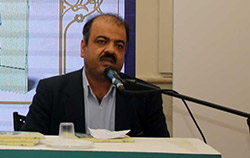
Abolfazl Hassanabadi, the director of documents and press unit of Astan Quds Razavi’s[1] Library, said:" The book" Oral History Guide" by Donald Rich can be just named here. Some books, published in the field of oral history, only have the name of oral history but they are not used in their original form.
Referring to a book written in the field of oral history, he added: "The book "Oral History in Iran" is one I have written in this field, in which I have tried to present a definition of oral history based on world standards and paid partly attention on its situation in Iran. Of course, along with the two series articles, I have written about "Interview in Oral History" and "Methodology and Subjects in Urban Studies" that can help the readers in this field.
Hassanabadi went on to say:" Dr. Morteza Nouraee has also written a book entitled "Oral History and Its Place in Iran's Contemporary Historiography in 1358-1385[2]" and said that oral history is an audio or video interview on a topic. Mr. Tatari has also published a book titled "Compilation in Oral History," which was the result of a series of articles on the subject of Oral History. Hassanabadi added:" in the year 1370(1991), Mrs. Bam published a book entitled "Transcription and Editing in Oral History," which somewhat defined a framework, but it should be noted that oral history has a structure and a fluid, diverse nature, and it can't be put in one framework. The standard principles of it should be regarded in order to have an oral history format."
Hasanabadi continued: "Oral history has a separate structure in each of its formats and may have a challengeable structure, or they are different from each other in terms of subject and narration, but there are in common principles on which the title of oral history takes place. Here, we have to categorize the frameworks and model them, and book's approach should be taken into account in compiling the book, which is, as a sample of the book, a literary approach, or a combination of story and reality, or like Mr. Mohsen Kazemi's books, has a particular approach and cannot be considered as an arbitrary one."
He explained standard principles in oral history: "The purposefulness of an interview, audio or video, the presence of the interviewee and interviewer is standard principles in oral history. We may meet standards in the initial production of oral history, but we are so different about using it that there are various types of oral history in the world. Regarding the use of oral history in Iran, of course, we are dropped behind and generally know it only belong in published books."
[1] It is a charitable foundation, in Mashhad, Iran. It is the administrative organization which manages the Imam Reza shrine and various institutions which belong to the organization.
[2] 2006-1979
Number of Visits: 5184
Share


The latest
- Encountering Oral History from a Theatrical Perspective
- 100 Questions/51
- The Third Regiment: Memoirs of an Iraqi Prisoner of War-51
- Family History; A Legacy for Future Generations
- Oral History News for August 23rd – September 22nd 2026
- Report of the Third Meeting of the Specialized Roundtable on Oral History of the Country
- 100 Questions/50
- The Third Regiment: Memoirs of an Iraqi Prisoner of War - 50
Most visited
- Narrative and the "War of Narratives" in the Era of Resistance and Imposed Wars
- Call for Fundamental Questions in the Field of Oral History
- Memories of Mohammad Boloori
- The Third Regiment: Memoirs of an Iraqi Prisoner of War - 50
- Report of the Third Meeting of the Specialized Roundtable on Oral History of the Country
- 100 Questions/50
- Oral History News for August 23rd – September 22nd 2026
- Family History; A Legacy for Future Generations
100 Questions / 43
How can narrators and interviewers reach a common understanding?We asked several researchers and activists in the field of oral history to express their views on oral history questions. The names of each participant are listed at the beginning of their answers, and the text of all answers will be published on this portal by the end of the week.
Documentary Pathology of the US Embassy Documents
The Necessity of Scientific Rereading and Content Analysis of DocumentsMore than four decades have passed since the publication of the first collections of documents from the US Embassy in Tehran. However, despite the relatively easy access to this treasure trove of documents, systematic research exploitation of it has not been adequate. We still do not have a “comprehensive picture” of the content of these 11,000 documents.
100 Questions / 42
What is the importance of the narrator and interviewers shared understanding of the past in oral history?We asked several researchers and activists in the field of oral history to express their views on oral history questions. The names of each participant are listed at the beginning of their answers, and the text of all the answers will be published on this portal by the end of the week.
Validation: Challenges and Necessities
Where does truth stand in oral history? How can the correctness of a narrative be recognized? Does fact-checking matter? If there is exaggeration in the reporting of some accounts, how can it be detected? Is it possible to record an event accurately through the recording of a narrative? Readers and users of oral history works are often faced with these questions, and sometimes encounter doubts about some oral history works.
