
Launch of Memoirs of Fattah Mohammadi
Writing Memoirs with Oral History Approach
Marjan Mir Qaffari
Translated by Natalie Haghverdian
2016-2-21
“No one had the strength to talk. Sitting in silence we were communicating with eyes. The sorrow of losing friends on one hand and our destiny unknown on the other had upset my mind. Still and quiet I was leaning to the corner of the trench when suddenly a mortar exploded nearby. Everything went dark. I passed out and came through when Iraqi soldiers were trying to pull me out of the trench. Couldn’t open my right eye and something had stock to my eyelid. I touched .my face to clean my eye. I touched it. It was soft. When I looked, it was a piece of meat from my martyr comrades.”
The narrative above represents a glimpse of the book “Fattah: Memoirs of Fattah Mohammadi in prisons of Iraq” which was launched on February 9, 2016 in Art Department of Mehr Hall attended by the Chief of Art Department and some other stakeholders and enthusiasts of Holy War books.
The book was published by the support of Culture and Sustainability Study and Art Department of Kohgiluyeh and BoyerAhmad Provinces by Soreye Mehr Publication as a first edition. Mitra Rafiyi has compiled memoirs of Dr. Fattah Mohammadi during the war imposed by Iraq in “Fattah” book.
Despite the fact that the narrative prose is close to fiction, all events are real and free from any imaginative and literary artifice; the story is all the narrator recounts as oral history. In other words, the book is a memoir with oral history approach.
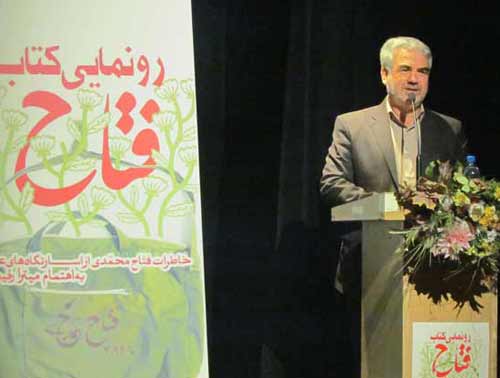
Fattah Mohammadi, narrator
Mitra Rafiyi in her interview with the report of Iran Oral History Site stated that the methodology in “Fattah” is oral history and emphasizes that first a documentary interview was conducted with the narrator and then research, clarification and interview with comrades and friends of the narrator.
She stated that the experience as obtained in compilation of memoirs of Fattah Mohammadi were highly effective and stressed that in her new survey and work which includes memoirs of Hassan Vakili she will adopt oral history methodology. This is due to the fact that oral history methodology addresses the need of the people today to know the truths of war.
Mohammad Qassemi Pour, management of cultural and stability studies of provinces covered by Art Department stated that this book is the second national vertu of Kohgilouyeh and BoyerAhmad province; the first one to be "The Foot that Left Behind" which is published by Sourye Mehr Publication. He stressed that compilation and recording of memoirs in “Fattah” is based on oral history approach and said: “The initial work to compile memoirs of Fattah Mohammadi, based on oral history approach, started in Office of Cultural and Stability Studies of Yasouj. Approximately thirty to forty hours of interview was conducted and when the script was prepared, review and technical work was done. Then approximately ten hours of complementary interviews were conducted.”
Qassemi Pour addressed an issue that the author has indicated in preamble of her book and said: “during the first interviews, the narrator was the sole speaker, but in time more interaction was established and turned into oral history methodology and the final product was presented in the form of oral histories of Mr. Mohammadi. In other words, the questions presented by the researcher are omitted and the format is not oral history; however the methodologies in recording and compiling memoirs are in the form of oral history.”
Hence, we hope that in new activities in Imposed War Literature and the Holy Defense, will be further associated with oral history. Since this approach will present the real ambiance of the time to the audience seeking to understand the truths.
Number of Visits: 5132
Share


The latest
- The Third Regiment: Memoirs of an Iraqi Prisoner of War - 50
- Narrative and the "War of Narratives" in the Era of Resistance and Imposed Wars
- Memories of Mohammad Boloori
- Call for Fundamental Questions in the Field of Oral History
- 100 Questions/49
- The Third Regiment: Memoirs of an Iraqi Prisoner of War - 49
- Jasem Ghazbanpour's narration of the first day of the war in Khorramshahr
- Memoirs of Ali Fadaei
Most visited
- 100 Questions/48
- The Relationship Between Oral History and Biography
- Jasem Ghazbanpour's narration of the first day of the war in Khorramshahr
- Memoirs of Ali Fadaei
- The Third Regiment: Memoirs of an Iraqi Prisoner of War - 49
- 100 Questions/49
- Call for Fundamental Questions in the Field of Oral History
- Memories of Mohammad Boloori
100 Questions / 43
How can narrators and interviewers reach a common understanding?We asked several researchers and activists in the field of oral history to express their views on oral history questions. The names of each participant are listed at the beginning of their answers, and the text of all answers will be published on this portal by the end of the week.
Documentary Pathology of the US Embassy Documents
The Necessity of Scientific Rereading and Content Analysis of DocumentsMore than four decades have passed since the publication of the first collections of documents from the US Embassy in Tehran. However, despite the relatively easy access to this treasure trove of documents, systematic research exploitation of it has not been adequate. We still do not have a “comprehensive picture” of the content of these 11,000 documents.
100 Questions / 42
What is the importance of the narrator and interviewers shared understanding of the past in oral history?We asked several researchers and activists in the field of oral history to express their views on oral history questions. The names of each participant are listed at the beginning of their answers, and the text of all the answers will be published on this portal by the end of the week.
Validation: Challenges and Necessities
Where does truth stand in oral history? How can the correctness of a narrative be recognized? Does fact-checking matter? If there is exaggeration in the reporting of some accounts, how can it be detected? Is it possible to record an event accurately through the recording of a narrative? Readers and users of oral history works are often faced with these questions, and sometimes encounter doubts about some oral history works.
