
Industrial and Mining Development Bank of Iran (1)
Narrated by Ali Zirak Nejad
Mehdi Amani Yamin
Translated by Natalie Haghverdian
2016-1-26
Note: At the launch of Third Development Plan (1962 – 1967) the Government of Iran believed that investment in various industries in the private sector requires a credit and investment institutions equipped with experienced management and competent staff to establish investment policies and pursue them. Also, it was settled that such institution shall have access to banking and investment institutions in industrial countries and maintain constant communication for Iranian institutions to benefit their invaluable experience and establish progressive relation to attract investment and technical expertise required for industrial development of Iran. On the other hand, for such institution to realize the objectives as provisioned it had to be set up within the private sector and its shares to be sold to European and American banks; however, majority of shares had to be maintained in Iran. Hence in 1958 the Government invited Lazard Frères & Co and Chase International Investment Corporation, with their headquarters in New York to set up a board of founders to establish Industrial and Mining Development Bank of Iran including various foreign investment corporations and prominent Iranian industrial features. The provision was made and the bank started its activity on October 13, 1959. When the bank was set up, majority of its management and staff, were foreigners. In 1960, the contract term of many of these managers including the General Director expired and Planning Organization invited Dr. Abolghasem Kheradjou, who was working in World Bank at the time, to take the management position. Kheradjou was manager of the bank from 1960 to 1978.
In this interview, Ali Zirak Nejad, Senior Financial Expert who has been the manager in charge of the treasury of Industrial and Mining Development Bank of Iran defines attributes of the bank, its procedures, personality of Abolghasem Kheradjou and resources and measures of the bank.
* Mr. Zirak Nejad, please start by introducing yourself.
I’m Ali Zirak Nejad born in January 1945 and graduated in mathematics from high school. Then I joint the military service and in 1961 was admitted to Accounting Faculty of Oil Company[1]. I was employed in Industrial and Mining Development Bank of Iran the same year. Our classes were usually from 15:00 to 20:00 hours and education in this faculty was subject to the fact that every student had to be involved in relevant financial affairs. In this way, theory and practice would develop parallel to one another and the students would have a better understanding of the subject. In 1972 I got my Masters degree in Financial Sciences and Accounting. In fact, I also participated in short term courses such as “Financial Statement Analysis” in Iran Center for Management Studies which was a subsidiary of Harvard University and now it is Imam Sadegh University and late Abolghasem Kheradjou was a professor of that center. Most of the professors in that center were from Harvard University and the language of the class was English. When I was studying there the quality of education was very good. I’ve also participated in other courses such as “Industrial Economy”; there are so many of these courses that I’ve been trained in.
The reason of my interest to conduct this interview besides all the efforts that one shall make for literature to remain is the debt that I have to Industrial Development Bank and late Kheradjou. What I’ve learned in my profession has been due to the leadership and management of late Khradjou who was a prominent figure in the country and his efforts are exemplary. He was a professional. He was one of the managers of the World Bank and IFC Company. He was a manager supervising Japan after II World War. He had studied Economics and was a charter accountant and a credible manager in World Bank. In his speech, he defined our business with Japan and said: this is my seventy fifth trips to Japan. He would constantly travel to Japan when he was with the World Bank and International Company.
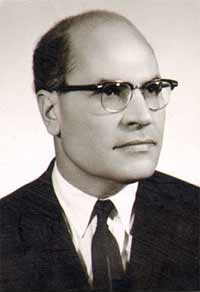
Abolghasem Kheradjou
*When did late Kheradjou state this fact?
Industrial and Mining Development Bank was founded in 1959 but I think his speech was in 73-74; however he was referring to all his trips to Japan. I mean, since he had started in World Bank and then when he was in Industrial Development Bank. I want to say that after war he was the supervisor in charge of World Bank for Japan. Professionally he was respected and counseled by national authorities both in Iran and at global level. In other countries he was known as Qasem. He was well respected and known and welcomed everywhere. In my experience when I joined World Bank and had a meeting with an IFC manager he asked: “Where did you work previously?” I was commissioned by Ministry of Finance so I said IMDB (Industrial and Mining Development Bank of Iran. He said: “we should send our children for internship there to study under Qasem’s supervision!” This was one of the points that I wanted to tell and the other one is with regards to foreign loans.
What I learned was in my working environment; what I studied at university and my experience in the bank were complementary and I have extensive experience. Hence I consider myself in debt of the Bank and I owe it to late Kheradjou and when I travel to USA I visit his grave.
*Where is he buried?
He is in Washington, Arlington Nation Cemetery. There are two cemeteries. One is governmental and one for ordinary people; he is there.
To be continued….
[1] Faculty of Accounting and Financial Sciences of National Oil Organization is one of the most prominent and credible faculties in Iran.
Number of Visits: 20714
Share


The latest
- 100 Questions/49
- The Third Regiment: Memoirs of an Iraqi Prisoner of War - 49
- Jasem Ghazbanpour's narration of the first day of the war in Khorramshahr
- Memoirs of Ali Fadaei
- The Relationship Between Oral History and Biography
- 100 Questions/48
- The Third Regiment: Memoirs of an Iraqi Prisoner of War - 48
- Seventh Theory: The evolutionary duality of document and narrative
Most visited
- The Third Regiment: Memoirs of an Iraqi Prisoner of War - 48
- The Relationship Between Oral History and Biography
- Seventh Theory: The evolutionary duality of document and narrative
- 100 Questions/48
- Memories of Davoud Molaei
- Memoirs of Ali Fadaei
- Jasem Ghazbanpour's narration of the first day of the war in Khorramshahr
- The Third Regiment: Memoirs of an Iraqi Prisoner of War - 49
100 Questions / 43
How can narrators and interviewers reach a common understanding?We asked several researchers and activists in the field of oral history to express their views on oral history questions. The names of each participant are listed at the beginning of their answers, and the text of all answers will be published on this portal by the end of the week.
Documentary Pathology of the US Embassy Documents
The Necessity of Scientific Rereading and Content Analysis of DocumentsMore than four decades have passed since the publication of the first collections of documents from the US Embassy in Tehran. However, despite the relatively easy access to this treasure trove of documents, systematic research exploitation of it has not been adequate. We still do not have a “comprehensive picture” of the content of these 11,000 documents.
100 Questions / 42
What is the importance of the narrator and interviewers shared understanding of the past in oral history?We asked several researchers and activists in the field of oral history to express their views on oral history questions. The names of each participant are listed at the beginning of their answers, and the text of all the answers will be published on this portal by the end of the week.
Validation: Challenges and Necessities
Where does truth stand in oral history? How can the correctness of a narrative be recognized? Does fact-checking matter? If there is exaggeration in the reporting of some accounts, how can it be detected? Is it possible to record an event accurately through the recording of a narrative? Readers and users of oral history works are often faced with these questions, and sometimes encounter doubts about some oral history works.
