
3rd Annual Conference, Bogotá, Colombia, July 7-8-9, 2016
2015-8-1
IFPH-FIPH 3rd Annual Conference, Bogotá, Colombia, July 7-8-9, 2016
Call for Papers for #IFPH2016
Deadline for Proposals: October 19, 2015
History is a public issue. Historical knowledge and practice is not limited to academic settings. History is also produced and shared in a wide range of settings by professional and non-professional historians alike. Museums and other exhibiting places, films and documentaries, historical novels, anniversaries and commemorations, re-enactments and living history, public policies, transitional justice commissions, television, radio, websites, and social media, are some of the venues in which history comes alive. All these settings stimulate interaction and collaboration with large audiences, turning historians into public historians.
The third international annual conference of the International Federation on Public History (IFPH) will be held at the Universidad de Los Andes in Bogotá, Colombia from July 7th to July 9th 2016. Its goal is to open up a space to give visibility and to share the innovative practices and skills that public historians around the world creatively use in their daily practice. History is increasingly produced through collaborative projects that are used for different political, economic, and cultural purposes, often defining collective identities along the way. Furthermore, public history explores, challenges, and discusses the historians’ role and has recently attracted global attention. In this sense, the Conference also provides room to discuss the scope, aims, and challenges, among other critical issues raised by public history and history as a general field.
Created in 2011, the IFPH aims at building an international and multi-lingual community of practitioners. IFPH role is to foster the development of Public History worldwide creating and coordinating networks, promoting teaching, research and all kind of activities engaging the public with the past, history and individual and collective memories.
The IFPH international conference in Bogotá will bring together practitioners, experts and activists from all over the world to discuss and share their experiences in the many challenges and rewards involved in engaging with the public to diffuse historical knowledge. The conference will not be limited to a specific theme but, on the contrary, will engage with the very different public history activities. So, proposals may present examples of historians’ engagement with communities through different media, building different forms of narratives and looking at different public uses of the past.
Possible practices and topics may include:
- Museums and Exhibiting the Past
- Oral History and Community Projects
- Digital Public History
- Digital Media, the Internet and Participatory Knowledge
- Mapping and Visual Representations of the Past
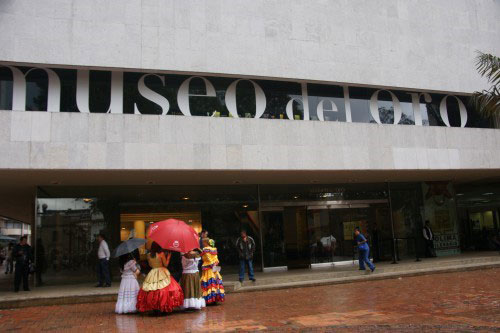
Museo del Oro, Bogotà, 2011
- Moving Images and documentaries
- Historical Fiction
- Re-enactments and Living History
- Historic Preservation and Community Cultural Heritage
- Public Archaeology
- Social Media, Mobile App and User-Generated Contents
- Public Policies and Applied History
- Teaching Public History
- Who are the Public Historians in Latin America?
- How to foster Public History as a discipline in Latin America?
- Difficult pasts interacting with the present: Historians and Social Justice, Human Rights, Truth Commissions and Transitional Justice.
Presentations in English or in Spanish will be accepted during the conference, but all proposals must be written in English. English is strongly suggested as the primary language for presentations.
Both individual papers and session proposals (90 minutes each) are welcome. Session proposals should include a general abstract for the session as well as abstracts for all individual papers.
Deadline for all proposals is October 19, 2015.
Poster sessions will also take place in Bogota with a different call and deadline.
Please send your proposal of no more than 150 words, as well as any questions or inquiries, to the following email: ifph2016@uniandes.edu.co
PROGRAM COMMITTEE:
- Gennaro Carotenuto (Università di Macerata, Italy)
- Thomas Cauvin (University of Lafayette, USA)
- David Dean (Carleton University, Canada)
- Anita Lucchesi (Université du Luxembourg, Luxembourg)
- Serge Noiret (European University Institute, Florence, Italy)
- Anaclet Pons (Universitat de València, Spain)
- Camilo Quintero (Universidad de los Andes, Colombia)
- Philip Scarpino (Indiana University-Purdue University Indianapolis – IUPUI, USA)
- Isabelle Veyrat-Masson (CNRS, France)
LOCAL COMMITTEE
- Camilo Quintero (Universidad de los Andes, Colombia) <cquinter [at] uniandes.edu.co>
- Angela Maria Aristizabal Borrero (Universidad de los Andes, Colombia) <am.aristizabal10 [at] uniandes.edu.co>
Number of Visits: 7632



The latest
- Practical Models for Simulating Texts in Distinguished, Signature Styles, Under the Use of AI Tools in Resistance Literature
- A Recollection by Ali Tahiri of a Military maneuver
- 100 Questions/17
- Third Regiment: Memoirs of an Iraqi Prisoner of War Doctor – 17
- Oral History News of December-January 2026
- Analyzing the Impact of Sacred Defense Memories on the New Generation: Usage in Transmitting Values
- The Sha‘baniyya Uprising as Narrated by Ali Tahiri
- 100 Questions/16
Most visited
- Oral History News of December-January 2026
- Third Regiment: Memoirs of an Iraqi Prisoner of War Doctor – 16
- The Sha‘baniyya Uprising as Narrated by Ali Tahiri
- Analyzing the Impact of Sacred Defense Memories on the New Generation: Usage in Transmitting Values
- 100 Questions/16
- Third Regiment: Memoirs of an Iraqi Prisoner of War Doctor – 17
- 100 Questions/17
- A Recollection by Ali Tahiri of a Military maneuver
Oral History of 40 Years
One of the main hypotheses regarding the reason for the growth and expansion of oral history in the modern era relates to the fact that oral history is the best tool for addressing lesser-known topics of contemporary history. Topics that, particularly because little information is available about them, have received less attention.Omissions in the Editing of Oral History
After the completion of interview sessions, the original recordings are archived, the interviews are transcribed, proofread, and re-listened to. If the material possesses the qualities required for publication in the form of an article or a book, the editing process must begin. In general, understanding a verbatim transcription of an interview is often not straightforward and requires editing so that it may be transformed into a fluent, well-documented text that is easy to comprehend.100 Questions/8
We asked several researchers and activists in the field of oral history to express their views on oral history questions. The names of each participant are listed at the beginning of their answers, and the text of all answers will be published on this portal by the end of the week. The goal of this project is to open new doors to an issue and promote scientific discussions in the field of oral history.The Role of Objects in Oral Narrative
Philosophers refer to anything that exists—or possesses the potential to exist—as an object. This concept may manifest in material forms, abstract notions, and even human emotions and lived experiences. In other words, an object encompasses a vast spectrum of beings and phenomena, each endowed with particular attributes and characteristics, and apprehensible in diverse modalities.
