Hiroshima Travelogue - Episode 3
It is pleasantly sultry. In the morning we leave for a museum called the “The Center of the Tokyo Raids and Was Damageâ€. It's a small 3-story building. A polite old woman welcomes us in. We take the steps to the second floor and take a seat. A film is being displayed about the horrific bombing of Tokyo by US forces. During the wee small hours of March 10 1945, almost 300 B-29 fighters bombarded Shitamachi town in Tokyo. They say over 100,000 died in the US-made hell and some one million were displaced as a result of the bombing. The air strike, according to the museum's guide book, is one of the 100 aerial bombings of Tokyo by US fighters. The places where the bombs fell are marked in a large map of the city. The film is a recreated documentary about a mother trying to salvage her children. Burned, ploughed ground is only thing left of Tokyo as it is shown in the movie.
All the museum staff are elderly. They say they have volunteered to work in the museum, which is run by contributions from people interested in preserving remnants of the dreadful event. The museum is constructed at one of the most devastated areas of the city. Some of the staff are survivors of the bombardment.
A man with grey hair tells me they have their own issues managing the museum. "Sometimes mediocre research budgets are offered by government officials. We have gathered the memories of some 30 of the survivors. Student groups may drop by to visit here, but tourists never come around."
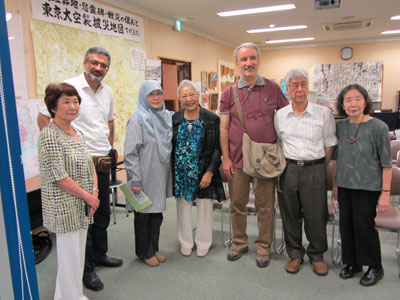
We are still sitting. Alireza Yazdan Panah, whose lungs are the storehouse of chemical coughs, gets up. He coughs at the start and begins with the name of God. He utters some sentences with all the hardship from his damaged lungs: "I was 9 when Iraqi forces invaded Iran. I went to the front at the age of 16 when the war was about to reach an end. In a chemical assault, I severely hurt my eyes and lungs and had my skin burnt. We, too, are concerned with war and invasion at Tehran Peace Museum. We don’t wish any other nation to go through such bitter experiences."
He coughs his speech to the end.
An aged woman, 82, is a survivor of Tokyo bombing. She says she was 14 and a high school student when the incident happened. "At that time, we imagined nothing but the victory of the emperor. To that effect, I dropped out of school and started out a career in a factory. We worked tirelessly and believed that we would betray our country if we rested. On March 10, a bomb fell near our house. My father decided that we should migrate. It took us a day to walk to the station. There, I saw a real burnt city. The streets could not be figured out. Many others had walked to the station before us. We went to Shimane. I sewed army uniforms. I could not keep on my studies. Six of my teachers and 26 of my classmates died in the bombing."
"We had a plan for our victory," said the old woman peacefully. "But we had no plan for a loss. We did not even imaging a failure in the war. We had every faith to our victory. We regarded the US and the UK as enemies. In fact, all foreigners were considered enemies. I should say I think differently now. Today, I would like to tell you that we should be friends and colleagues to each other."
I get up to walk about the small museum. There are pictures, frames, documents, garments, shrapnel, etc. behind glasses and on the war. We spend about half an hour in the three stories of the museum. I safely shake a hand with the old woman when saying goodbye.
We received a handmade, paper bird. The bird is made in memory of Sadako, a girl killed in Hiroshima Atomic Bombardment.
To be continued…
By Habibollah Behboudi
Translated into English by Abbas Hajihashemi
Number of Visits: 5809



The latest
- The Third Regiment: Memoirs of an Iraqi Prisoner of War-40
- Theory Four: The Crisis of Border Legitimacy
- A Look at the Book of the Restless Anonymous
- 100 Questions / 39
- A Classmates Narration of Martyr Zahra Haddad Adel
- The Third Regiment: Memoirs of an Iraqi Prisoner of War-39
- Explaining the “Use of Oral History in Writing Entries”
- 100 Questions / 38
Most visited
- Oral History News of May 22nd to June 21st 2026
- 100 Questions / 38
- Examining the Differences in the Oral History Method of the Revolution and the War
- Explaining the “Use of Oral History in Writing Entries”
- A Classmates Narration of Martyr Zahra Haddad Adel
- The Third Regiment: Memoirs of an Iraqi Prisoner of War-39
- 100 Questions / 39
- A Look at the Book of the Restless Anonymous
100 Questions/ 34
To what extent are we allowed to use narrative techniques (however simple) in compiling an oral history text?We asked several researchers and activists in the field of oral history to express their views on oral history questions. The names of each participant are listed at the beginning of their answers, and the text of all answers will be published on this portal by the end of the week.
Validation: Challenges and Necessities
Where does truth stand in oral history? How can the correctness of a narrative be recognized? Does fact-checking matter? If there is exaggeration in the reporting of some accounts, how can it be detected? Is it possible to record an event accurately through the recording of a narrative? Readers and users of oral history works are often faced with these questions, and sometimes encounter doubts about some oral history works.From Revolutionary Circles to the Military Arm of the Islamic Government
In those days, it became clear that certain institutions had to be established very quickly—institutions suited to the temperament, expectations, and lingering aspirations of the younger generation; young people who had been politically active before the Revolution and, in some cases, had been directly entangled in arrests, imprisonment, ...Authenticating Oral History: From Possibility to Necessity
The use of oral history as one of the historical sources has long been one of the principal challenges facing oral historians and those who employ it in contemporary historiography. The development of international standards for oral history, as well as IRIB standards, was intended to address the criticisms raised in this regard. The relationship between Diplomatics in written records and oral history is reciprocal.