
The Story of a Street Classroom
When the city square becomes a school deskInterview and compilation by Faezeh Sasanikhah
Translate by Kianoush Borzouei
2026-05-20
While many schools have been facing closures under wartime conditions, one teacher, guided by a spirit of sacrifice and a deep sense of professional responsibility, has chosen a different path. In this interview, Ms. Samira Gheybi speaks about how she has been imparting knowledge to her students, helping them overcome fear, and trying to preserve the continuity of education during these difficult days. This compassionate teacher has also been serving her fellow citizens in other ways throughout the hardships of war. Below is our conversation with her.
***
How long have you been teaching?
I have been teaching in various districts of Tehran since around 2007, and since 2015 I have been working in elementary education. This year (April 2026), I teach fifth and sixth grade at Alavi Islamic Girls’ Elementary School in District 12.
What motivated you to hold classes during the nightly gatherings?
Our martyred Leader said two years ago: “I expect teachers to regard their students as their own children and to love them.” Truly, I do see my students as my own children. Many of my students wanted to sit for the gifted-school entrance exam this year, and I had already devoted a great deal of time to them from the beginning of the year. Even before the war, although school ended at 1 p.m., I would continue working with them until 5 p.m. In addition to lessons and academic exercises, we also had cultural activities. We had a very strong group, especially academically, and I felt it would be a shame to let all that effort go to waste. On the other hand, I was distressed when I saw that some of my students were struggling to learn in online classes, or were not learning at all. Among them were students who were academically weak, and I worried about them. As soon as I realized that those weaker students were still in Tehran, I became determined to hold in-person classes so they could successfully complete sixth grade.
When did you begin holding class on the street?
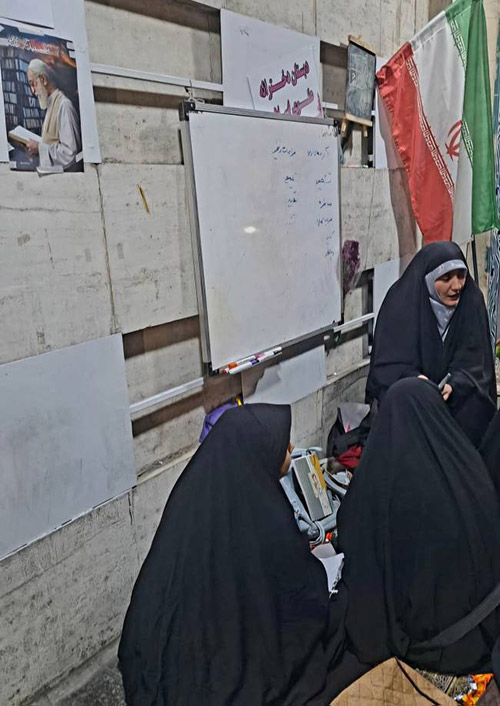
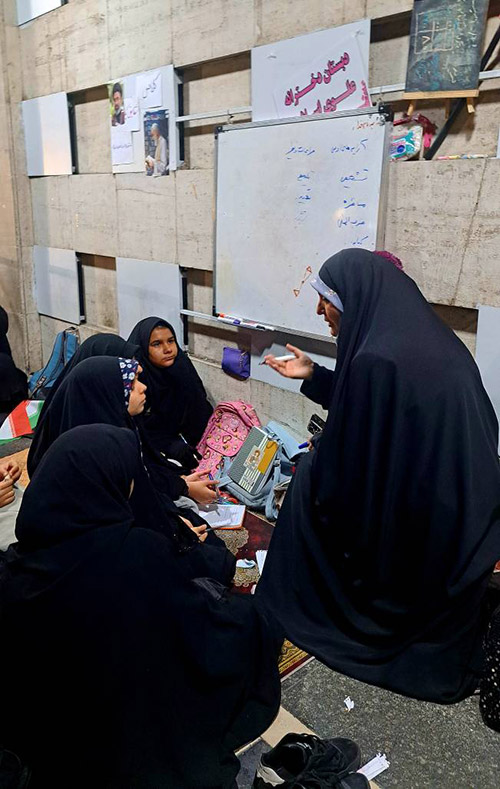
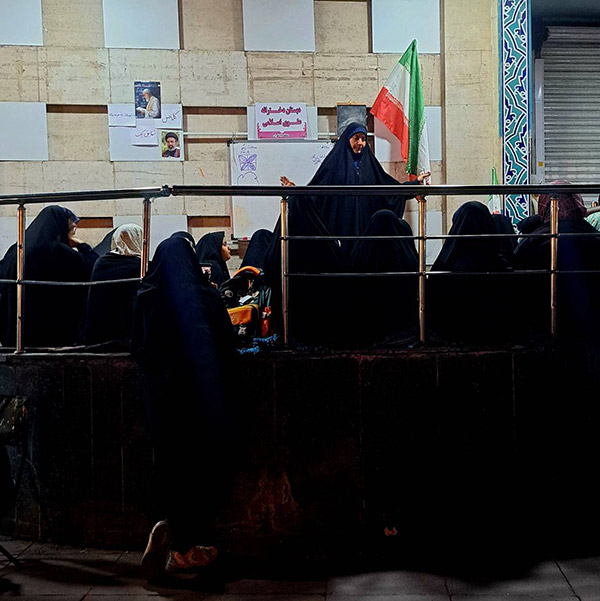
We were supposed to start virtual classes after Nowruz holidays. My students did not like online classes. Some of them said, “Teacher, let’s make a group of five or six and meet at one another’s homes so you can teach us.” I thought long and hard about what to do. Eventually, it occurred to me that since we we’re already going out every night to attend the gatherings, I could gather the students in a corner of the square and hold class for them there. When I raised the idea with our principal, she worried it might create problems. I said, “First, this class is being held in the street; second, my work is not directly under the Ministry of Education, so it does not require a permit. I will discuss it with the mothers and see what they think.” First, I announced it in my students’ group to see how many were still in Tehran. Out of forty-two students, about twenty-six were in Tehran, and the rest were traveling back and forth. The children said that if class were formed, they would attend. Then I spoke with the mothers and asked their opinion. They said they were in favor; at least ten of them stated that their children would participate in the in-person street classes. On April 4th, the first night after the holidays, I met my students in Shohada Square. We gathered in front of the pharmacy. The square was extremely crowded, and I was looking for a suitable spot. We came into Mojahidin-e Eslam Street and found the Melli Bank platform, which was a good place for a small, compact class, and that was where we held our class. Since we were away from the square, the noise was less disruptive. We have been holding class here ever since.
What was your first reaction when you saw your students, and how did they respond to you?
We were all extremely excited and happy. I kissed and hugged them. Their reunion with one another and with me was a hopeful moment for them. We had not seen each other for about 40 days. That night, we spoke with the children and I taught them. In fact, during that hour and a half, I wanted to test whether this idea was feasible or not.
How did you evaluate that first session?
It was very productive. I was able to resolve many of the students’ difficulties. After I held the second and third sessions, I reported back to the principal and said, “From now on, I will conduct my class this way, students who can attend in person will do so; the others can study virtually the next day and do not need to participate in the general online class.”
How many hours do you teach?
From 7:30 p.m. until 11 p.m. I teach for an hour and a half to two hours, and then I help them with their questions. Before and after class begins, the children ask me about the gifted-school exam or their textbooks.
There is a lot of noise here—traffic, loudspeakers, pedestrians passing by. How do you manage the class?
My arrangement with the students is that they should pay attention to what I say. But in general, a very useful feature of our location is that the students sit with their backs to the passersby and do not see them.
What time do you usually get home at night?
Usually around 12:30 a.m.
Do you live near Shohada Square?
No. We live in Hakimieh, in Tehranpars.
Does your family have any problem with this schedule?
When we began the class in the square, the ceasefire had not yet been declared. Our area was among those most frequently attacked by the enemy. At first, my family was worried something might happen, but later they were reassured. Even before the ceasefire, we had to travel to Taleqan for some matter. On Wednesday, I had class with my students. I came to Tehran and, after class, returned to Taleqan again.
Besides you, there are several other teachers and students here. What is their presence about?
Our colleagues in Ministry of Education wanted to hold a memorial for the forty days since the martyrdom of the students and teachers from the school in Minab. In a group I belong to, I said: “We want to do cultural work. In my view, teachers should gather in memory of the Minab students and, in their honor, teach students who are struggling academically.” They agreed and said, “We will set up a symbolic booth.” Then they issued a call among public and private schools in District 12; everyone gathered, and it was decided that from that day onward they would also begin their classes. Praise be to God, the teachers of Alavi Islamic School, encouraged by their respected principal—who had seen the results of my class—also began holding classes for their own students.
Has anything interesting happened while teaching during this time?
Yes. One day, while I was teaching the lesson on discounts, a street seller came and sold us some dish covers and pot holders. The price was 350,000 tomans. We negotiated and bought them for 300,000 tomans. Then I asked the seller, “How much did you buy these for yourself?” He said, “250,000 tomans.” I said, “So you bought them for 250,000 tomans and made a profit of 50,000 tomans.” In this way, I taught my students the concept of profit in a practical manner. I have a point system; I gave the dish covers as gifts to the students with the highest scores.
What are the best memories you have had from this new experience so far?
At school, if someone neglected their duties, I would penalize them by having them cook something and bring it for the whole class. One night, one of the girls brought bread she had baked herself. Another night, a student cooked food and brought it in a container for everyone. Another student also brought sweet halva on the night of the martyrdom of Imam Sadiq, peace be upon him. For me, the fact that they are eager to prepare something and share it is more exciting than anything else.
Another matter concerns charity work. What we do here is not merely teaching; I have tried to carry into these street classes the same initiatives I used to run at school. Before the war, on the occasion of the birth of Imam Hasan al-Mujtaba, peace be upon him, we had a campaign. We had prepared small food packages that were meant to be given to students so they could take them home, turn them into larger packages, and, in the name of Imam Hasan, gift them to a needy family on the night of his birth so that the family would be happy. But we saw that the packages had not been prepared, so we went to the school, obtained permission from the principal, and took the packages out. Some were packed in students’ homes, and the rest of the work continued here by the roadside. On the birth night of her honor, Ms. Masoumeh, we also carried out this campaign in the street—that is, we distributed bags to everyone and wrote a message on them. We launched this campaign on the recommendation of our leader, Agha Mojtaba Khamenei, who said: “Take care of one another.” We had a QR code through which people could scan and join the channel to see how the packages were being prepared and view the related photos and videos. Then they would send us photos and videos of their own package preparation, and we would share them with others. This campaign has been running since the birth night of Ms. Masoumeh, peace be upon her. Those who know a needy person themselves deliver the packages to them, and those who do not have anyone nearby hand the package to us so that we can deliver it to those in need. In addition to all this, we also celebrated the birthdays of students who had birthdays during this period, just as we did at school. We also marked Girls’ Day here; we put pink balloons on the wall, turned the classroom pink, and celebrated. The mothers also prepared snacks and cake. Even the Imam Reza Tea House, located in the municipality grounds next to the Melli Bank, when it saw that we were celebrating Girls’ Day, kindly gave us tea specially.
How do passersby react when they walk by here?
Some stop and watch us with surprise or admiration, and take photos and videos.
Did it happen that while teaching, an attack occurred and air defense responded?
Yes. On the first few days we heard the sound of air defense and explosions, especially during the first two or three sessions, but the children remained calm beside one another. Before the war began, I had anticipated the possibility of war and spoke extensively with my students about the process of war.
What do you mean by “preparing the students”?
I held training sessions for them—for example, under the pretext of the geography lesson. In Iran studies, we examined all of Iran’s neighbors, the size of the countries, their distance from us, the Muslims in our region, how Israel was formed, and so on. I explained where the United States is and spoke to them about America’s military power. For instance, what would happen if a warship or aircraft came here? What is the state of our military equipment? How have warfare models changed? What capabilities did we have during the eight years of Sacred Defense, and where do we stand now in terms of military power? I also spoke about our military advances and missile capabilities. In addition, I discussed the protests of January 2026, the twelve-day war, and the broader impact of the severe sanctions we are under. The information I gave them deepened their awareness and boosted their self-confidence. In fact, the sense that we are capable of responding to the enemy’s attack helped greatly in reducing their fear.
What was the students’ reaction on the first day of the war?
They were not upset that the war had started; rather, they were worried about what would happen to our future plans. We did not know what lay ahead. I told my students, “If Israel were attacked, what would its students do? They would run away; but you are calm.” Until the mothers arrived and the school was evacuated, we chanted slogans and recited battle poetry. My students, instead of crying and screaming, sat in the school corridor and did their homework until their mothers came.
You could have held the class online; why did you go to so much trouble?
We are responsible for these students. I believe that when the enemy attacks us, each of us is obliged to do whatever we can within our own area of expertise. I hold a doctorate in counseling, so based on my specialization, during the first two or three weeks of the war—before I began holding the street classes—I would take up a position in clinics introduced by the neighborhood as a form of volunteer service, and for two to three hours a day I would provide free counseling to visitors and teach methods for treating stress, maintaining calm, and so on.
In addition, some of my friends said that in the south of the city there were students whose teachers had left for other towns when the war began, and they did not even have virtual classes. From March 11th onward, in the mornings we would gather in one of the mosques in that area and teach different grades, from first to sixth, while also helping with problem-solving. My work would take about five hours. This continued through Nowruz and is still ongoing; since I started classes for my own students, I have classes here on even days and there on odd days.
What is your wish for the classes you are holding?
My first wish is the advent of Imam al-Zaman, may God hasten his reappearance. My great hope is that every step I take and every moment I devote to this work will be accepted in His sight and that He will bestow His special grace. Each of these students is a precious asset of this revolution. In the next decade, when we step aside, the burden of the country will rest on their shoulders, and they will all be over twenty years old. I hope to be there then and see each of them succeed in different fields. Nothing excites me more than seeing students whom I brought to class amid war, noise, and all kinds of complications later succeed—and being able to say, “Thank God, my effort was effective.”
How much of what you are doing now has been influenced by what you heard about the efforts of the fighters and volunteers during the eight years of Sacred Defense?
I spent all of my adolescence surrounded by the memories of the martyrs. The martyrs gave me motivation, hope, and dynamism. I lived with them and kept my ear to the words of our martyred Leader. I tried to give my utmost and transmit those values to my students. I do not know how successful I have been in teaching them a sense of scientific and spiritual dynamism—being active, motivated, and hopeful—but these are the qualities the martyrs passed on to us. My heartfelt wish is that not only my students, but all students, become the enduring good deeds of this revolution, so that the whole world may envy every moment of their lives. Of course, this will only be achieved when I, in my role as a teacher, fulfill my duty properly, promptly, and at the right time—whether in war or in peace.
Number of Visits: 384
http://oral-history.ir/?page=post&id=13290