
Jasem Ghazbanpour's narration of the first day of the war in Khorramshahr
Interview and editing: Maryam Asadi Jafari
Machine Translation Edited by Mandana Karimi
2026-9-24
Oral History Website - On the eve of the 46th anniversary of the start of the imposed war against Iran by Iraq, we intended to visit one of the photographers of the Sacred Defense era and record a different narrative of the first days of the conflict in the south of the country. Who better than southern photographers! Southern artists who unwittingly became involved in bitter and difficult experiences in their teens and learned photography and warfare together. The following text is the narrative of "Jasem Ghazbanpour", one of the Iranian photographers, from the first days of Iraq's invasion of Iranian soil and the occupation of Khorramshahr. Ghazbanpour, who was a teenager during those days, experienced Red Crescent relief work and photography, and his life changed overnight. Later, in his book "Memories of the Neighbor", he put together images of the graffiti of Iraqi soldiers on the walls of Khorramshahr to show how important the profession of photography is in the visual recording of history. Contrary to our expectations, rather than having the atmosphere of photography in the midst of war, Jasem Ghazbanpour's memoirs took on the color and aroma of the maturity and masculinity of the teenagers of Khorramshahr.
The First Wound on Khorramshahr's Body
The date of the start of the war is one thing for me and the children of Khorramshahr, and another for you. In our opinion, the start of the war is the end of 1978. Because Khorramshahr was actually involved in the war from the beginning of 1979. The conflicts between the Arab people, guerrillas, etc., began in the middle of 1979, and at that time, Iraq began sending weapons to Iran in bulk. You could go to the border every night and, by telling the Iraqis the code of the night, you could receive any type of weapon you wanted; from Kalashnikovs and Colts to RPGs and grenades; weapons that did not have serial numbers and the wooden handles were not painted so that they would not be identified. Some people even bought and sold weapons. I remember, a Kalash was about 5,500 to 6,000 Tomans. So the war began in earnest for us from the beginning of 1979; Not September and October!
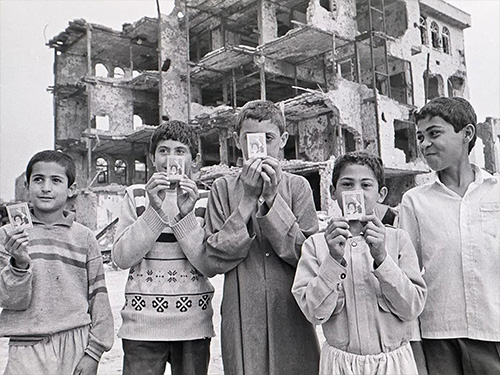
We had been martyred on our borders since early 1970. At that time, the group of martyr [Mohammad] Jahanara or the Jahanaras was formed and the war began. People from many villages, including the border villages and the areas between Pol-e-No and Shalamcheh or Sad-e-Dastgah to Shalamcheh, migrated to Khorramshahr in the summer of 1970 as war victims and were accommodated in schools and stadiums by the Red Crescent. I was a member of the photography group of the Red Crescent Youth House. I didn’t have a camera myself and I wanted to get a camera. Mr. Taresh was in charge of the photography group. I wanted to go and take pictures with the children who were helping and with the ambulances that were going to transport the officials to Khorramshahr.
Many reports were made that Khorramshahr was getting involved in the war and that Iraq was importing weapons into Khorramshahr. But unfortunately, none of the officials paid any attention to this issue. A number of children from Khorramshahr had gone to Mr. Gharazi and asked for weapons and help. Gharazi was very small; even compared to me at that time, he was small and his face did not match his age. He had slapped one of them on the back and said: “You are still too young to realize that Khorramshahr is falling. Can Khorramshahr fall? Go. Go back to your hometown!” The children were crying. Most of the children from Khorramshahr who were fighting were young and teenagers. Most of them, like me, were high school students or rarely university students, and mainly former students of the Persian Gulf University or Jondishapur. For example, Al-Fath or Bazargan High School, where I, Martyr Jahanara, Martyr Moradi, and many other guys had studied. As I said, the conflicts began shortly after the Islamic Revolution. The first military training course I attended was before the Yes or No referendum. We were in a group with Martyr Rasoul Noorani. He was even younger than me. We were a group of 10 to 15 people. We went to the fortress barracks and saw the Z3 course. During the elections, we were also the poll watchmen. The war in Khorramshahr started much earlier and its damage was there much earlier than what is written in history.
“Khamseh Khamse” and “Khorramshahr”
I had ordered a camera from Mr. Sahraiyan's Sasan Photography to bring it to me. I was supposed to receive it on the 20th or 21st of September 1970. I had saved 15,000 Tomans and wanted to buy it. That same day, we received our final year of education results - that is, our diploma. I was supposed to buy a camera and its accessories from Mr. Sahraiyan with Mr. Taresh, who was my close friend, and start working and go to the border and take pictures with the aid workers. Towards evening, I went to the Red Crescent. I picked up Mr. Taresh and we went to the Red Crescent. At that moment, "Seyyed", the person in charge of the aid workers in the border strip, came to the Red Crescent. "Seyyed" was in charge of the aid workers who had been stationed at the border for a month or two and were providing services to the combatant children. - I say all this and emphasize that the guys had been fighting and stationed on the border for two months. – We were standing right at the entrance to the Khorramshahr Red Crescent. Sayed came and we greeted each other. We said, “Thank God you came, I’ll go get a camera and come with you to the border strip.” He said, “Iraq has announced that it will strike Khorramshahr tonight.” It was surprising to us. Because we had no idea about weapons and war. We asked, “What kind of strike will it take at this distance?” He said, “It has something called Khamseh Khamseh.” As Seyyed was explaining that this is what war is like, I heard the first howl of a mortar. It landed exactly 50 to a hundred meters from the Red Crescent entrance, towards the railway square. Seyyed said, “This is what I was saying!” and so it started...
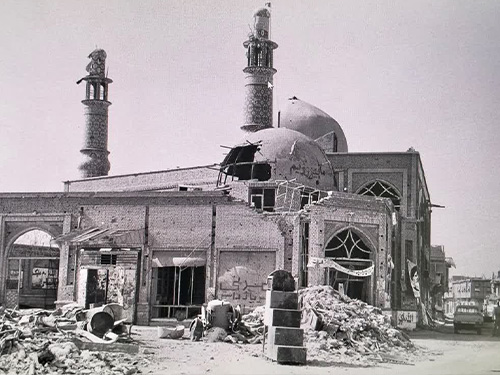
The Khorramshahr Red Crescent was located in the railway square. On one side of the square was the railway. On the other side was the Red Crescent Garden, which was also very large. On the other side of the square was a road that came from Ahvaz and went straight to the port and customs gate of Khorramshahr. That night, Khorramshahr was massacred; it was seriously massacred. First, the camera incident was ruled out. Because we wanted to help as rescuers. Mr. Taresh and I got on our Vespa motorcycle - which I still have - and went. We saw bullets raining from the sky. We went to the Shat. We saw the Navy start firing at Iraq with a 106 cannon and on this side of Khorramshahr, people were on the boulevard at the edge of the Shat; In front of the municipality building and at the end of the coastal street that led to the port authority, they clapped their hands and cheered for the naval gunfire, taking refuge behind the juniper trees or the trees on the coastal boulevard. No one had any idea that if a missile came, that 10-15 cm tree trunk wouldn't stop anything! It would turn into shrapnel! That night, we started helping with the relief workers.
Growing Up Overnight
That night we announced that anyone who has a mattress or cotton quilt should leave it at the door. We need cotton to collect the bodies in the city. That night, the gasoline issue was also ruled out and the stations were not guarded. The next morning, the banks were closed. This means that Khorramshahr seriously entered the war phase. First Khorramshahr and then Abadan. That night, the Ahvaz-Khorramshahr road almost fell and nothing stood in the way of the Iraqis. Iraq wanted to bypass Khorramshahr, take the Ahvaz-Khorramshahr road, then Darkhoin-Abadan and then the Mahshahr road and completely separate these two cities from Iran, but fortunately they did not succeed. The story of the resistance of the fighters of Khorramshahr with empty hands lasted 45 days.
In the first two or three days, I took my family out of Khorramshahr and returned to work as an aid worker and photographer. Overnight, we went from being a 17-year-old teenager to a fighter and a father of a family. Because my father suffered from philosophical shock and despair on the very first night of the war. One day before the war, he was a ship supervisor and a wealthy man. On the morning of the war, overnight, he became an ordinary person who had nothing and could not decide what to do. As a result, we became the father of the family, the breadwinner of the family, a fighter, a rescuer and a photographer.
I don't remember, I think there was a liter of gasoline in the engine tank. I poured it into the tank of the arrow. I put the family and the children, who were very young, in the car to take me to Shadegan. We poured gasoline into the car's fuel tank. We started it, then poured oil into the car's tank. We were in Shadegan for a night or two and in Behbahan for a night or two when I managed to get at least 10-15 liters of gasoline and oil. I started the car on the uphills of the Behbahan mountains to Shiraz and turned it off on the downhills. I learned that when I turn it off, I should not turn the switch all the way down so that the steering wheel locks. It took me a week to get them to Shiraz and Marvdasht. The money I had put in to buy the camera was in my National Bank passbook, and since I had not yet reached the legal age, my father could naturally use that passbook. I had already put the passbook in my pocket so that I could go to the bank in the morning, take out the money, and give it to Mr. Sahraiyan, but that didn't happen. I gave the passbook to them. We arrived in Marvdasht in the afternoon. I arrived in Shiraz in the middle of the night. I got on the bus and returned to the region and the front. Until 1993, I was a soldier, I studied, I was a father, I was a photographer, and I did whatever I could.
The Most Bitter Memory…
Every house that was hit by a mortar in Khorramshahr, the entire family was killed. Because all the family members were gathered together. The thought of those days is very terrifying to me now. I am currently making a painting of the martyrs of Ahvaz in 1982. You can see the painting so that you can understand what I mean when I say terrifying?!
What Ms. Hosseini describes in her book “Da” about the 45-day resistance is a very small part of the story of those days, and of course it is true. Many who came to bury their martyrs were also killed. The mortars hit next to them or on their bodies and they were also killed, and there were so many that it is indescribable. At that time, short denim jackets and jeans were fashionable, and I also had a piece of them and wore them. Ms. Hosseini says in her memoirs that there was a young man in jeans who only took pictures of the bodies. But he didn't know my name. Later, I met him and his family and became friends and comrades with his wife. He always joked, “Do you remember the first days of the war, when you wore jeans and a denim jacket?”
There are a few photos from those days. Of course, I took photos with a friend’s camera. He had given me his camera for repair so I could take a look at it; it had a problem. On the first night of the war, when I went to see Mr. Taresh, I had bought two rolls of black and white film and these were in my pocket. They had been in my pocket for about 15-20 days. Finally, I went to our house and took that camera and put two rolls of black and white film in it and took photos. Unfortunately, their negatives are lost, but their photos are there. In most of the photos, I am present myself providing relief. I also took a few photos of the displaced and war-torn people in Shadegan and the atmosphere of Khorramshahr. This was the whole story of the beginning of the war and our first encounter with the war. Later, as Jahanara's friends, under the command of martyr Jahanara and with the presence of other friends such as Mr. Foruzandeh, Noorani, and Eskandari, groups and brigades were formed, and some were together until the end of the Jerusalem operation and some until the end of the war.
Those were very difficult and bitter days. But the bitterest thing for me in those days was the indifference of some officials. This was more bitter than seeing all those bodies of martyrs and the lack of medicine, weapons, and help, and it still remains in my mind and scratches my soul every hour and every day.
Number of Visits: 15
Share


The latest
- Jasem Ghazbanpour's narration of the first day of the war in Khorramshahr
- Memoirs of Ali Fadaei
- The Relationship Between Oral History and Biography
- 100 Questions/48
- The Third Regiment: Memoirs of an Iraqi Prisoner of War - 48
- Seventh Theory: The evolutionary duality of document and narrative
- Memories of Davoud Molaei
- Preparing a report for Khorasan Radio and Television
Most visited
- Servants Narration of the Religious Rituals of the Holy Shrine of Imam Reza (AS) From Tradition to Lived Experience
- Preparing a report for Khorasan Radio and Television
- The Third Regiment: Memoirs of an Iraqi Prisoner of War - 47
- 100 Questions/47
- Memories of Davoud Molaei
- The Third Regiment: Memoirs of an Iraqi Prisoner of War - 48
- Seventh Theory: The evolutionary duality of document and narrative
- 100 Questions/48
100 Questions / 43
How can narrators and interviewers reach a common understanding?We asked several researchers and activists in the field of oral history to express their views on oral history questions. The names of each participant are listed at the beginning of their answers, and the text of all answers will be published on this portal by the end of the week.
Documentary Pathology of the US Embassy Documents
The Necessity of Scientific Rereading and Content Analysis of DocumentsMore than four decades have passed since the publication of the first collections of documents from the US Embassy in Tehran. However, despite the relatively easy access to this treasure trove of documents, systematic research exploitation of it has not been adequate. We still do not have a “comprehensive picture” of the content of these 11,000 documents.
100 Questions / 42
What is the importance of the narrator and interviewers shared understanding of the past in oral history?We asked several researchers and activists in the field of oral history to express their views on oral history questions. The names of each participant are listed at the beginning of their answers, and the text of all the answers will be published on this portal by the end of the week.
Validation: Challenges and Necessities
Where does truth stand in oral history? How can the correctness of a narrative be recognized? Does fact-checking matter? If there is exaggeration in the reporting of some accounts, how can it be detected? Is it possible to record an event accurately through the recording of a narrative? Readers and users of oral history works are often faced with these questions, and sometimes encounter doubts about some oral history works.
