
Bakhtiari Narrator of Minab School
From the Mobile Procession to a Month of Sympathy
Mohammad Mehdi Abdollahzadeh
Machine Translation Edited By Mandana Karimi
2026-7-28
revolution. If you do not narrate, the enemy will narrate. If you do not narrate the revolution, the enemy will narrate. If you do not narrate the incident of the Sacred Defense, the enemy will narrate. He will justify it however, he wants. He will lie [and that is] 180 degrees against the truth; he will change the place of the oppressor and the oppressed.”[1]
Narration is one of the manifestations of soft war, and whoever narrates it sooner will be more successful in this field. This art requires knowledge, creativity, special tools, and above all, a strong motivation. What you read below is the result of a one-hour interview with a motivated Bakhtiari youth who became the narrator of the "Shajareh-ye Minab" school tragedy. The national solidarity between Iranian subcultures is clearly visible in this report.
***
Mohammad Chaharlang, born in 1988 in Ramhormoz, spent his elementary school years in Zahedan and completed his middle school and art school in Ahvaz. He was a soldier in Dezful and Isfahan in 2008 and 2009. After his military service, he opened a gasoline-powered car repair shop in the beginning of the Razmandegan Township of Ahvaz. His skill and honesty made his business flourish, and he always had at least one student.
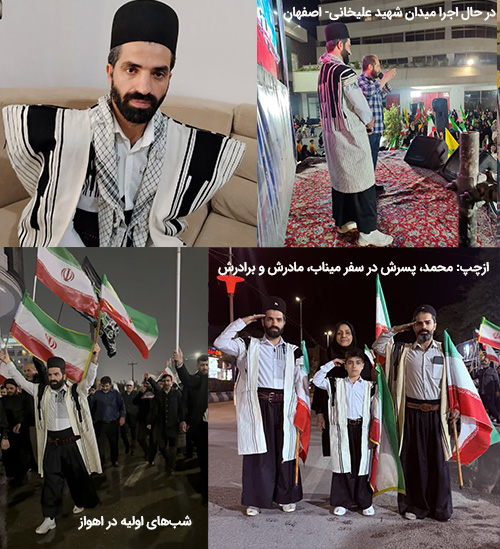
His father, Gholamali, is a retired steel company employee and holds a PhD. He is a full-fledged Basij and a regular attendee of Friday prayers and religious and political ceremonies in Ahvaz. A significant percentage of Ahvaz residents, including the Chaharlang family, are from the Lor tribe. Gholamali is also a local confidant and a member of the “Khuzestan Province Peace Center” and plays an active role in resolving local disputes.
In 2021, Mohammad bought a Volkswagen van to use as a mobile procession on occasions such as Tasua and Ashura. The hangout of this procession, which mostly serves drinks, is in front of the tomb of Ali ibn Mahziyar in Ahvaz. He is interested in the history of the Lor people and is deeply saddened by the oppression of this people during the Pahlavi era. For this reason, he also tells stories about Bibi Maryam and Ali Mardan Khan. Mohammad is married to Seyyedeh Mina Mousavi and has a ten-year-old son named Abolfazl.
With the American and Israeli attack on June 13, 2025 and the beginning of the Twelve-Day War, Mohammad’s presence at the Popular Mobilization bases increased; although his life was still as usual, with the beginning of the unrest in January 2026, he no longer had the heart and mind to work seriously in the shop and thought that his duty was elsewhere. However, he still reluctantly kept the shop open. On February 28, 2026 (10th of Ramadan), when the news of the enemy's renewed attack spread, he did not go to the store out of sadness. The news of the assassinations had also doubled his anxiety. On the night of the tenth of Ramadan, he was awake until near dawn and fell asleep after dawn. It was in the middle of a heavy sleep that his brother Hussein shook his shoulder and cried out, “Mohammad, get up, the leader has been targeted!” Mohammad stood up in shock. At first, he said sadly, "Don't listen to these rumors!" However, the flowing tears of his mother, Soheila Bahmani, the blows that Hussein was hitting him on the head and face, and the television announcement confirmed everything. Mohammad, along with the family, began to wail and lament. Mohammad served in shifts at checkpoints with his father, wearing the local Bakhtiari dress. His sister also regularly attended gatherings with her mother, who had developed mobility problems. However, after the grief of martyrdom, the news of the enemy’s attack on the “Shajareh-ye Tayyebeh Minab” elementary school saddened him more than anything else did. In this attack, 156 people were martyred, 120 of whom were students. After thinking for two or three days, Mohammad concluded that he had to do something for these oppressed martyrs. His idea was to decorate the four sides of his car with the photos of these martyrs to turn it into a mobile cultural procession.
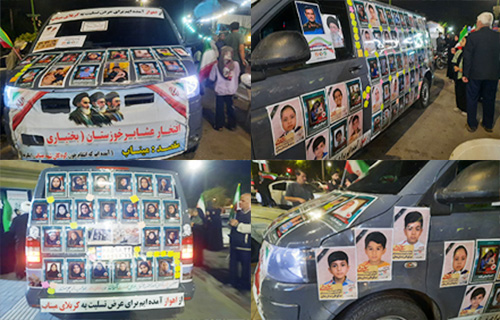
He prepared the photos and, at a cost of several million, prepared them to be mounted on his van. On March 8, together with his mother and family members, they mounted the photos and stuck papers for viewers to take notes under each photo. From March 9, Mohammad appeared in Ahvaz’s gatherings with this mobile procession. In a short time, he participated in fifteen gatherings in the city, and the welcome from the people, journalists, and Khuzestan Radio and Television made him more confident in his right path. A few days later, two more people in Arab (dashdashe) and Bakhtiari costumes joined him. They went to nearby cities such as Susangerd, Hamidieh, and Shadegan, and people watched their pictures and notes again. Several people also donated money to participate in this good deed.
On April 3 and 4, Mohammad attended the funeral of the martyred general Tangsiri in Abadan, along with his father and several others in Bakhtiari costumes. The more his procession was welcomed, the more the fire inside him flared up. Finally, he decided to go to Minab to meet the families of the martyrs up close.
He set off for Hormozgan with “Mansour Abyat” from the Arabs of Khuzestan (who came in Arab costume and a double-barreled hunting rifle) and “Mr. Alipour” in Bakhtiari costume. He also took his ten-year-old son, Abolfazl, with him.
In Bandar Abbas, they participated in a ceremony in front of the university on the first day. The van with the pictures and the local costumes of the entourage attracted everyone's attention. Mohammad was asked to go up on stage and speak. He, who was surprised, controlled himself and first spoke about the Bakhtiari tribe, the Pahlavi oppression and the history of this tribe's resistance to oppression, and narrated about Bibi Maryam and Ali Mardan Khan. Then, with an emotional tone, he spoke about the martyrs of Minab and that he had come to this land to offer his condolences. The Bandar Abbas municipality provided them with accommodation and hospitality, and Mohammad continued to speak at various events for the next three nights.
When they reached Minab, the mood of the group changed considerably and they spoke mostly with tears in their eyes. First, they went to visit the destroyed school. Many of the families of the martyrs were still there and it was interesting for them to see sympathizers from Khuzestan. The families mostly chanted slogans for the martyred leader and were sad. From the IRGC, the Martyrs’ Foundation, the Governor’s Office, and several other departments were also present.
Mohammad had become a listening ear and a mourner for the families of the martyrs, and he was thirsty for their stories to be heard. They were given accommodation at the Relief Committee, but the cultural family of Yahyainejad, who were themselves the organizers, invited them to their home and hosted this group of narrators.
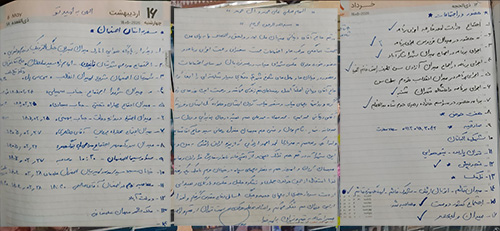
Every day, Mohammad, along with several local officials and clerics, would go to the homes of one or two martyrs in Minab, the villages, and the subordinate districts, and listen to their conversations. While filming and recording, he would ask many of them to write their memories in his notebook. They visited villages such as Damshahr, Haji Khademi, Rawang, Islamabad, Zohoki, and the Tak’hor region (which had four martyrs of the Dena Destroyer) and the historical village of Sarni (where six martyrs of the Dena Destroyer were there).
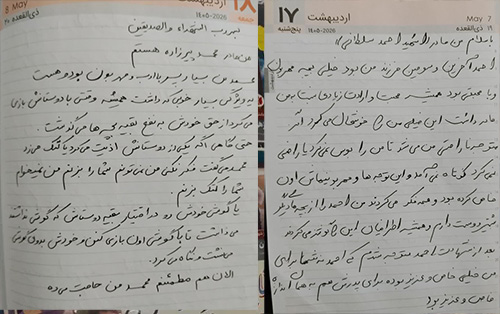
This trip took about a month. Mohammad’s companions returned to Ahvaz by bus due to local responsibilities, but Mohammad decided to continue his mission in the cities on the way back. He narrated stories about the martyrs of Minab and their families to people in Kerman (2 days), Rafsanjan (4 days), and Sirjan (1 day).
When he reached Yazd, he realized that the rocky roads of Minab had damaged the van and that the mud and humidity had worn away the pictures of the martyrs. With the efforts of a few friends, they replaced the pictures and renovated the van. He stayed in Yazd for eight days and nights and spoke at more than 30 gatherings in Yazd, Ardakan, Na’in, and Kuhpayeh (although he was unsuccessful in Meybod). His method was that in each gathering, after a brief explanation of the Minab incident, he would tell a story about one of the martyrs. His strong memory helped him to narrate precise details that were attractive to everyone. The provinces of Fars, Isfahan, Kashan, & Qom also hosted him, and he was able to speak about the oppression of the martyrs of Minab in their gatherings.
When he returned to Ahvaz, a few days later he went to Mashhad with his wife to attend the funeral of the martyred leader while recounting the story of the martyrs. On his return, he also visited Neyshabur, Sabzevar, Shahrood, Damghan, Semnan, and Garmsar, and he intends to continue to the northern cities.
Mohammad spoke mostly about the love and companionship of the people on this long journey, but in response to the question of how the counter-revolutionaries would react, he replied, “If there is companionship, I am willing to go abroad in this van and narrate this historical event through an interpreter. Although the ignorance of some people caused my car tires to get flat, my mirrors to break, some photos to tear, my windshield wipers to fall out of place, or we had to sleep in the car for some nights, the value of the work is so high that these costs are nothing.” In the end, he narrated his mood with a verse from Rumi:
If you want to walk in the desert with the desire for the Kaaba, the reproaches of the thorny bush will make you sad.[2]
[1] Statements of the Supreme Leader of the Martyrs in a meeting with nurses and families of health martyrs
[2] The interview conducted on July 14, 2026 at the home of Colonel Ali Alemi, the narrator's host.
Number of Visits: 722
Share


The latest
- 100 Questions/48
- The Third Regiment: Memoirs of an Iraqi Prisoner of War - 48
- Seventh Theory: The evolutionary duality of document and narrative
- Memories of Davoud Molaei
- Preparing a report for Khorasan Radio and Television
- 100 Questions/47
- The Third Regiment: Memoirs of an Iraqi Prisoner of War - 47
- Servants Narration of the Religious Rituals of the Holy Shrine of Imam Reza (AS) From Tradition to Lived Experience
Most visited
- Memories of Nasrollah Fat’hian
- Servants Narration of the Religious Rituals of the Holy Shrine of Imam Reza (AS) From Tradition to Lived Experience
- Memories of Hossein Ali Najafian
- The Third Regiment: Memoirs of an Iraqi Prisoner of War - 47
- 100 Questions/47
- Preparing a report for Khorasan Radio and Television
- Memories of Davoud Molaei
- Seventh Theory: The evolutionary duality of document and narrative
100 Questions / 43
How can narrators and interviewers reach a common understanding?We asked several researchers and activists in the field of oral history to express their views on oral history questions. The names of each participant are listed at the beginning of their answers, and the text of all answers will be published on this portal by the end of the week.
Documentary Pathology of the US Embassy Documents
The Necessity of Scientific Rereading and Content Analysis of DocumentsMore than four decades have passed since the publication of the first collections of documents from the US Embassy in Tehran. However, despite the relatively easy access to this treasure trove of documents, systematic research exploitation of it has not been adequate. We still do not have a “comprehensive picture” of the content of these 11,000 documents.
100 Questions / 42
What is the importance of the narrator and interviewers shared understanding of the past in oral history?We asked several researchers and activists in the field of oral history to express their views on oral history questions. The names of each participant are listed at the beginning of their answers, and the text of all the answers will be published on this portal by the end of the week.
Validation: Challenges and Necessities
Where does truth stand in oral history? How can the correctness of a narrative be recognized? Does fact-checking matter? If there is exaggeration in the reporting of some accounts, how can it be detected? Is it possible to record an event accurately through the recording of a narrative? Readers and users of oral history works are often faced with these questions, and sometimes encounter doubts about some oral history works.
